
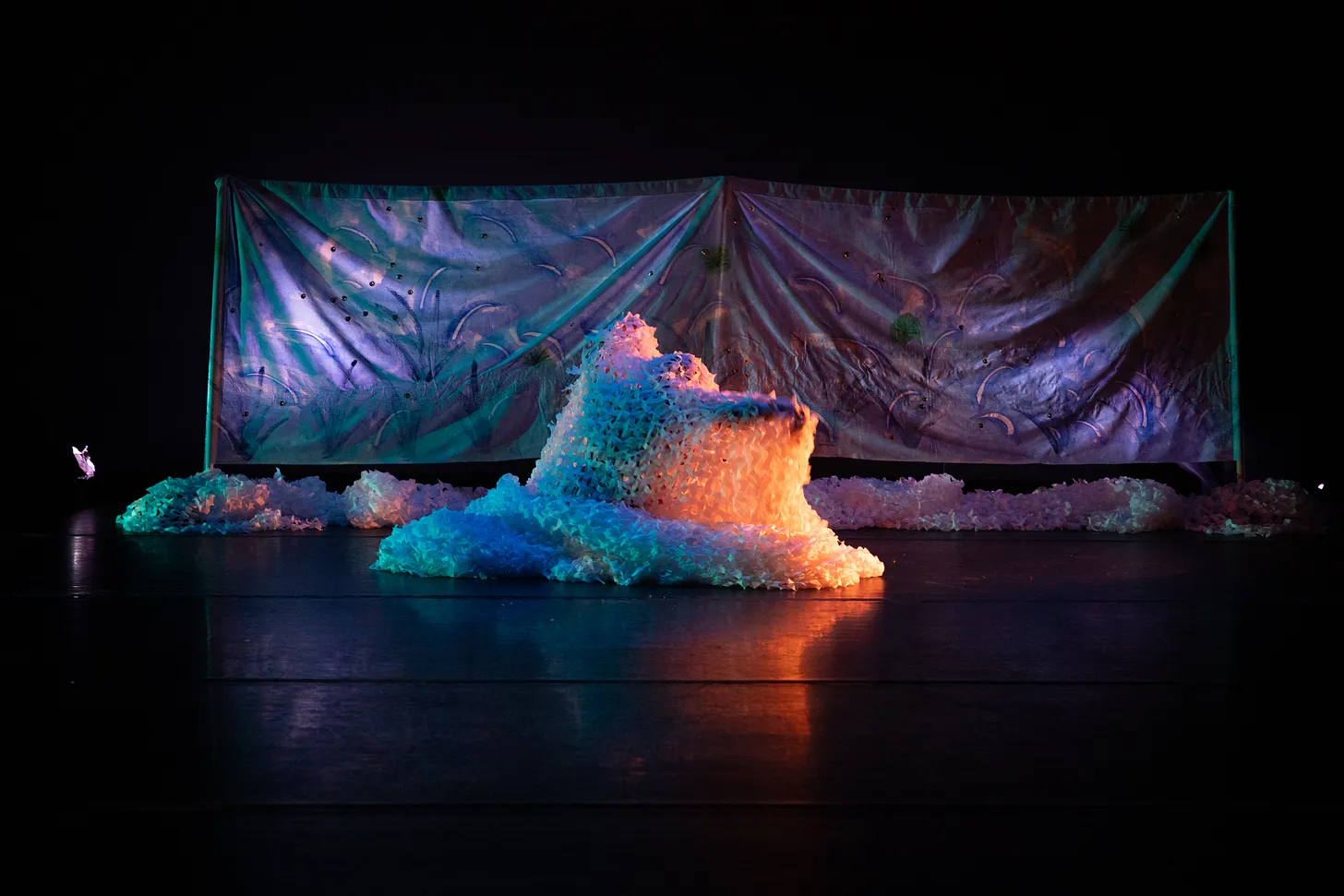
What if, rather than writing a review, a critic went to a dance show and then had a conversation with the artist? After seeing Bhumi B Patel’s premiere “wild light” at ODC Theater, freelance dance critic Rachel Howard decided to resurrect “Critical Dialogues,” a series she initiated at In Dance more than a decade ago.
Patel is a queer, desi artist/activist, dance scholar, and director of pateldanceworks. She earned her MA in American Dance Studies from Florida State University and her MFA in Dance from Mills College. A Dance/USA artist fellow and YBCA 100 honoree, she describes herself as “pursuing liberation through dancing, choreographing, curating, educating and writing/scholarship.”
Howard is a novelist, memoirist, and creative writing teacher who has written dance criticism for the San Francisco Chronicle. She also contributes to the international magazines Tanz and Fjord Review. She is currently editing an anthology, Dance Criticism for the Twenty-First Century: Towards New Practices and Relationships.
Patel and Howard met on Zoom two weeks after the December 4, 2025 premiere of “wild light,” danced by Patel and movement collaborators Ai Yin Adelski, Catalina O’Connor, Maxine Flasher-Düzgüneş, and monique jonath, with original compositions performed live by singer-composer Rachel Austin and visual design by Sa’dia Rehman.
This interview has been edited for length and clarity.
Howard: I want to start with your dance writing program, “imprint.” You selected four writers who have been receiving mentorship, going to shows, and writing for your dance company’s blog. How’s that going?
Patel: It’s incredible. When I was working on my dissertation, I focused on pieces created since about 2015, which was when amara tabor-smith started “House/Full of Blackwomen.” And as I was looking for writing about each of these works, specifically “This Bridge Called My Ass” by Miguel Gutierrez, and Gerald Casel’s “Not About Race Dance”—I did reference your work in Fjord Review on that—there were only a handful of writings. So that’s where the idea of “imprint” came from—combined with my being a pretty public and vocal proponent of queer and BIPOC voices being added to the canon.
During the “imprint” fellowship, we’ve discussed, where did dance writing even come from? Where did this divide of uptown and downtown in New York come from? And can we also think about Jill Johnston and Deborah Jowitt and all of these people who were trying to move dance writing forward, with care towards people who experience marginalization or oppression?
Howard: A question from my position as a freelance critic, speaking to you, a Ph.D. and a scholar: Do we still need criticism or do we only need documentation and scholarship?
Patel: I think there is a place for dance criticism. Also, dance criticism has done harm over time, right? Something I often ask when I’m reading criticism, especially when I’m reading historic criticism—because I think there’s something different happening in the present moment—I find myself asking, “How can we afford both the critic and the artist humanity?”
Howard: Agree. We need to have a new kind of relationship in which we are equal human beings.
Patel: So, in between my MA and my MFA, I lived in New York City, and for a semester, I did a program now called Arts in NYC through Florida State University. One requirement was seeing five shows a week. And something happened over that six months that changed the way I was seeing dance.
Howard: I relate to that. I had a formative period when I went to five or six shows a week, and then served as a panelist for the NEA. That level of saturation was very formative, although it also ended up, for me, being unsustainable.
Patel: It felt like a crash course in training my eye, because although we didn’t have to write criticism, we did have to write journals as part of the program, for every single show that we went to. There is value in having someone who sees tons of dance look at my work and not only put it in context of what’s happening in the field right now, but also offer that keen eye and attention. I think that training one’s eye and becoming expert on watching dance is a skill.
Howard: So you think there are things that come out in criticism that can’t come out to the same degree in previews or interviews or scholarship?
Patel: In my fantasyland, we have critics who are able to really get the lay of the land. They’re able to see patterns, to see common interests, to see trends, or questions that many artists are asking right now.
But something that I’ve noticed for a long time is that there aren’t many critics who are willing to say “I didn’t get it. I can’t be the expert on this.” Willing to say, “My training is A, B and C, and I truly don’t understand the performance. I enjoyed myself, but I can’t contextualize it for you.” Maybe that’s where the question of humanity comes in: We can be humans that aren’t expert on everything, right? We can have that trained eye while still having gaps.
Howard: I agree. About your premiere “wild light,” I did go see it with the possibility of writing about it. But I think, and maybe you can tell me if I’m making the wrong choice—as I mature, I am much less inclined to write a review unless I connected with the art in a passionate way. If it’s a performance that doesn’t scream “newsworthy” in a way I can explain to the reader and my editors, and I didn’t fall in love with the work . . . perhaps it’s cowardice on my part, but rather than write a negative or lukewarm review, I don’t write. Is that wrong?
Bhumi: Oh, I don’t know if I know about right and wrong. I think collectively as a society, there are some eggshells that we walk on, right? There have been times I’ve written reviews that were generally negative—not so much not liking the piece, but I didn’t think the piece did the thing that the program said the piece was going to do. I have seen the way that landed for the artist, and it has made me have a little bit more trepidation about what I want to say.
Howard: You were also a creative writing major in undergrad, and I teach creative writing, and have become much more comfortable leading workshops . . . does workshopping happen in the dance world? Some dance artists, when I’ve suggested that dance doesn’t have enough workshopping, pushed back and said workshopping happens in the studio, with the dancers giving feedback as the work is created. But if the dancers are already in your work, they can’t really see it from outside, you can’t have that same kind of conversation, right?
Patel: I love work in progress showings. I love open rehearsals. [But] when it comes to receiving feedback—this sounds terrible, but I’m not necessarily invested in whether someone likes it or doesn’t like it, right? We like what we like and we don’t like what we don’t like. And we’ve all had a million experiences that have brought us to this moment [of encountering the art]. We could have been sitting in the theater and been too hot or too cold, or had a bad day, or the seam on my shirt is itching my shoulder and it’s driving me crazy, right? I want to hear from people outside the process, but I want to know: What do you understand about this work at this point? What feelings are coming up for you? What is the story or the narrative that you see unfolding? As an artist, I often create an abstract story, or have my own storyboard for what’s happening on stage, an emotional arc that I want my viewer to go on.
Howard: This sounds similar to how I approach leading creative writing workshops. I feel it’s much more important to simply reflect back to the artist what your experience was—more important than offering judgments. But oftentimes, tough conversations happen: The writers who make the most out of workshop want to know more about the parts of the writing that didn’t connect with readers. I do ask workshop respondents to start by pointing to the passages and elements in the work that they were drawn to. So to transition to your work “wild light,” I thought that the music was a strong point. The live singer (composer Rachel Austin) was incredible. She created a really interesting soundscore, with the shifts between many genres and traditions. And I especially appreciated the ensemble movement. It was textured and propulsive, and compositionally layered. Also, a wonderful connection between the dancers.
And yet . . . maybe this is me being the audience member who’s got the itchy sweater on . . . but 90 minutes, no intermission felt very long. Was that something you anticipated?

Patel: I struggle in the sound bite, hyper-techno world we live in right now. Someone who I feel really inspired by is Eiko Otake—learning from her is a master class in patience—and I want to push people in that way. Could the piece have been shorter? Absolutely. But I wanted the viewer to have to enter that state of patience.
Howard: Interesting, because I also tend to like dance works that cultivate patience. And you know, a lot of butoh that I’ve seen, and postmodern work like Anna Halprin’s, can push you in that way. About your opening solo in “wild light,” I took that as your figure going through a cocoon birth under the white material you were wrapped in. And the pacing was certainly deliberate. Is it okay to say that it didn’t hook me the same way that, say, Eiko Otake’s dances have in the past, and it’s hard to explain why?
Patel: Sure. I don’t think slowness has to work for every viewer in every context.
Howard: Let’s get into the Donna Haraway material you were working with in “wild light.” She’s a feminist scholar famous for her “Cyborg Manifesto.” I did look her work up in general before I went, and I read the articles you’ve published about how you were inspired by “The Camille Stories.” I guess you expect a critic to come with a certain level of preparation from having looked at those sources. What do you expect from an audience member?
Patel: I don’t necessarily expect an audience member to have the context for my source material. I don’t necessarily know that people needed to know “The Camille Stories” to have a journey [through “wild light”], to stay with the narrative arc.
Howard: Mm, yeah, that’s where I was having a tricky time—staying with the narrative arc. I felt in touch with it in the beginning, with the birthing, and through the solo in the dress that you lip synched to the song, “If I Were a Man.” Very funny song, by the way. When the ensemble came in, there were gestures that I was intrigued by: standing on tiptoe, and peering with one eye through the hands. I saw shifts in how the dancers interacted with each other, but I wondered how much more of the arc would I have experienced had I read the actual story ahead of time.
Patel: I will say that the piece itself was my speculation on what happens at the very end of the story: it’s sort of a coda to Donna Haraway’s work, which is why it doesn’t feel so relevant to have read the story.
Howard: Okay, interesting. Just to recap what I know of “The Camille Stories:” the Camilles are symbionts between human beings and monarch butterflies. And Haraway’s idea here, from her manifesto, is that symbionts and cyborgs can blow open binaries because the binary between the human and the animal, the technological and the non-technological, the natural and the technological, and also male and female has been exploded. And with cyborgs and symbionts comes the potential to blow open even more binaries. Is that right?
Patel: And “The Camille Stories” is published in a text called Staying with the Trouble. An overarching idea is that, when we think about revolution and changing the world—what if it’s not about burning everything to the ground, but working with the troubles that we already have, in order to create the new?
Howard: So tell me more about how you were thinking about the arc of the “wild light,” because I didn’t catch on to it.
Patel: The story ends with Camille five. She dies in 2425, 400 years into the future. And by that time, we understand that this experiment with human-animal symbionts still has the potential to fail. So we’re still on this very troubled planet, trying to navigate our way through. That is where the dance starts. What I imagined is that the moment Camille five dies in 2425, she has to be revisited by Camilles one through four. She has to be ushered into ancestry. The arc is how do they, individually and together, grapple with the trouble that they left?

Howard: I’m wondering if you played with bringing in flashes of text or some anchor, perhaps an introduction of Camilles one through four, extra-textual clues. I tend towards thinking of art as creating a game between the creator and the person who’s taking it in. If the viewer has enough cues about the “game” that’s being played, the viewer has an extra level of engagement to read meaning into the work’s patterns. So did you consider using more cues, or was it difficult to reconcile that with your other aesthetic priorities?
Patel: I did think about using text and projection. And I ultimately decided to not be so explicit about the story. Selfishly, I have experienced a lot of satisfaction in hearing people develop their own narratives. Over the four performance nights, I heard so many stories that people had made up. I was so moved by the way people were receiving the story and placing it within the context of their own lives and struggles.
Howard: In that spirit, then, a comment on the costumes. I thought that the colors suggested both monarchs and Tibetan Buddhist monk robes. Is that something you intended?

Patel: I don’t know that I was specifically thinking “monk robes,” but we did want to create clothing for when you go through the veil to the other side. There is a sameness in the ghostliness of spirits that I was hoping to convey . . . [The Camille ancestors], they’re a team.

Howard: I see. So . . . I asked you all the questions today. Are there any questions you want to ask me?
Patel: I’m curious about where you land with these questions around the responsibility of critics. What are ethical practices of criticism?
Howard: Well, I think a lot of critics when they start out—or maybe this was just my personal fault—they want to prove themselves, as though making digs is going to give them authority. You grow and you get over that. But there is also a pressure that comes from some of the institutions themselves. If you’re writing for the New York Times or even for the Chronicle, they want you to state opinions from on high in an impersonal, quote-unquote “objective” way. I’m coming to believe it is a spiritual matter: It’s about claiming the subjective in such a deep way that you can make honest statements about your responses without pretending to be objective. I think it’s very important that a critic have an individual, particular voice. And then as a reader, what you’re interested in is not so much the thumbs up or thumbs down, but to follow this person’s mind and how they think about the work. But today there’s less cultivation of individual voices going on, and that’s a major problem.
Patel: Years ago, I had a mentor who told me she used to sit next to a critic at shows in New York City, and because that critic was making a midnight deadline for their review, they got up halfway through the show to go write. The purpose of that review was to publish it the next morning to encourage people to go to that show that weekend, right? I think we’re holding onto some conventions we don’t need.
Howard: I agree.
Patel: I also think it helps to recognize that I have a particular relationship to dance. My subjective view is the result of everything that I’ve experienced in my life, right?
Howard: Well, and all the things that you haven’t lived: You can be aware of your blind spots and honest about them, without making the review about you. That’s the sweet spot. And it’s tricky.
Patel: It is hard. And I’m not a magician, nor do I create utopias. But I do appreciate that these conversations are happening with the “imprint” fellowship. I don’t think in a year we’re going to solve the problem, but we can have conversations about how we might move towards addressing these questions.