
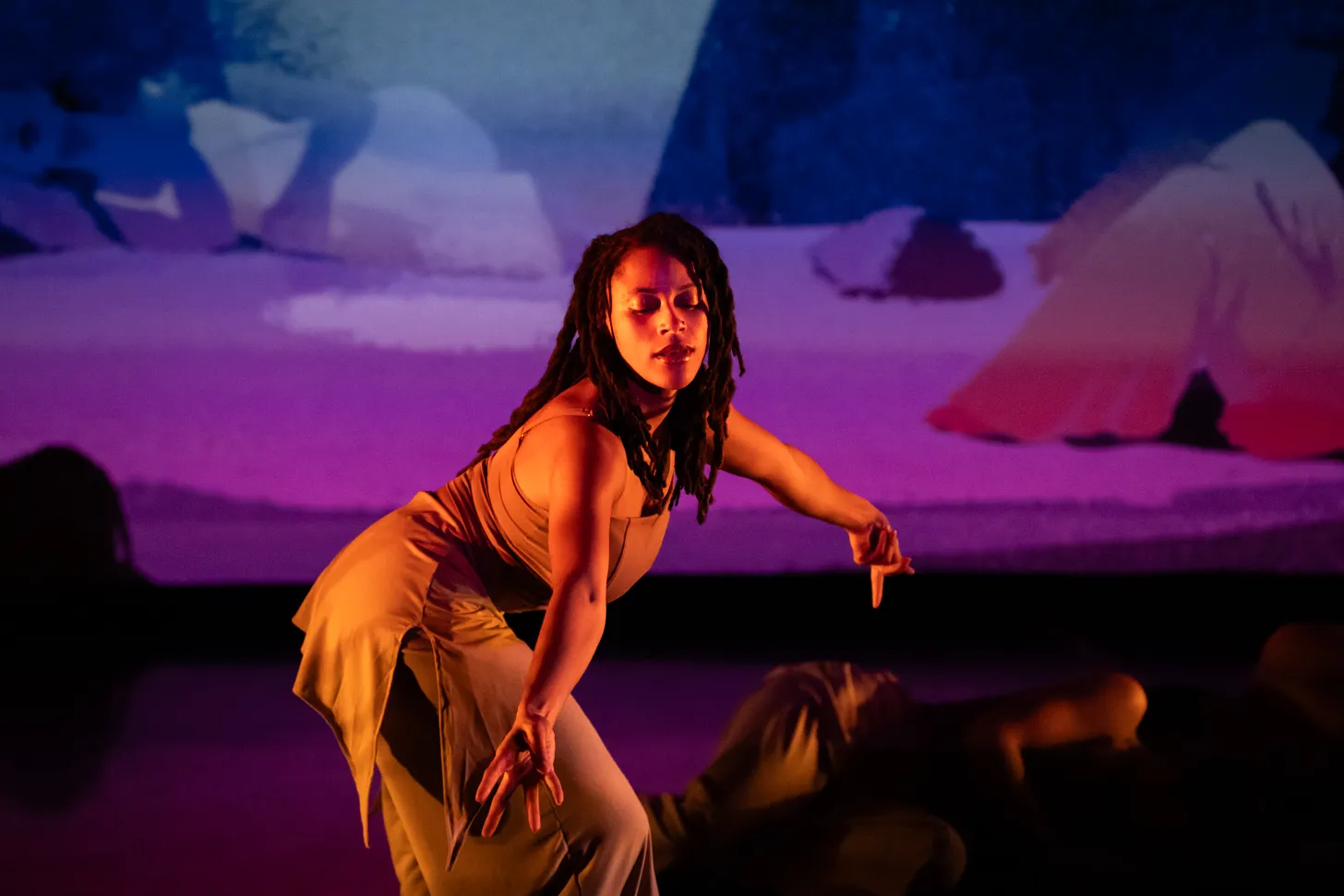
Ja’LUUM director Natalya Janay Shoaf. Photo credit: Btoopositive.
Melissa Hudson Bell: Let’s start with your name and any identifying tidbits that you want to tell me about yourself.
Natalya Janay Shoaf: My name is Natalya Janay Shoaf. I am a choreographer, educator, and performer here in the Bay Area. And I am the artistic director of Ja’LUUM, which is a pre-professional program that centers mentorship and artistic development through rigorous training and professional performance opportunities. We just premiered our first season, December 5th and 6th at Dance Mission Theater. And it was phenomenal!
MHB: It was a great show. I stayed for the talkback, so I got a little bit of the inside baseball. Can you tell me a little bit about the inspiration for the show?
NJS: The inspiration for the show came from listening. And it came from wanting to put out something that was really true and authentic and current to what I believe. So the show is basically a physical manifestation of what I believe to be true.
MHB: Like a mission statement.
NJS: Sure!
MHB: In choreographic form.
NJS: Like a thesis.
MHB: Is Ja’LUUM the name for the company, the training program, and the show?
NJS: Yes. I just named it all Ja’LUUM because that’s what I needed in that moment. Everything was Ja’LUUM. So the company’s name is Ja’LUUM, the performance name was Ja’LUUM, and the world that we inhabited was Ja’LUUM.
MHB: I’ve heard this once [at the talkback], but will you say again where the word came from?
NJS: Yes. Ja’LUUM came from a prayer that I made when I decided to travel to Costa Rica during the pandemic. I wanted something I could say to myself that made me feel safe as I took this solo venture across multiple countries. And the last three words of that prayer were Jaluum, Goya, Jaluum.
And when I started thinking about this next chapter, this new endeavor, how I wanted it to be, I just wanted it to be protected and guided and to go forward in its correct, divine, aligned direction. And Ja’LUUM just felt like the perfect word. It was something that was me.
MHB: You’re the origin of it. You defined it. It came through you.
NJS: More or less, yes.
MHB: So it’s also sort of the ethos of the program. Like, with the title, you wanted to convey ‘this is a safe training space.’
NJS: Yes. No more trauma drama. We don’t have the time for anything other than safe training spaces.
MHB: So how does that play out in how you hold space for the dancers?
NJS: It plays out very organically. I definitely set the tone through my own practice and how I step into the world and how I step into the room.
Inside my own world, I’ve developed a movement practice where my mantra is “progression, not perfection.” So as long as we’re moving forward, I’m very cool with it. I’m very, very cool with it.
With my dancers, I teach them how to capture the essence of the work. Yes, we’re going to get the choreography. Yes, we’re going to get the details. Yes, we’re going to work on it for many hours. But I want you to narrate it. The choreography is just the skeleton. The dancer adds all of the tendons, the meat, the skin. The life.
I really encourage them to go deeper into the movement and move beyond their technical training. To start to narrate what they’re perceiving. To fill the movement with their imagination. Sensation. What they’re experiencing. What they’re feeling. I want to be transported into their world.

MHB: And it should be noted that these dancers are, like, fifteen and sixteen years old.
NJS: Yes!
MHB: These young people were such impressive movers. Really, really focused, such a depth and richness to the movement. It’s so clear that they’ve spent those hours together.
NJS: Yeah..
MHB: There are four dancers right now?
NJS: Currently, yes. We just had auditions yesterday for season two.
MHB: How did those four come to you?
NJS: I had worked with them in other settings. And initially they didn’t really know what language I was speaking—it was new—but they were interested. And I felt like I could create with them and share what I had been working on with little judgment. Which is just necessary.
MHB: What does the training look like?
NJS: It varied throughout the year, but we trained a minimum of nine hours a week, three days a week. They all had strong technical foundations. A lot of them trained at Oakland School for the Arts under Savage and Miss Hurley. They did a really great job giving dancers a technical foundation.
MHB: What about you? What’s your movement history?
NJS: I started choreographing at eight at Stonehurst Elementary. I joined the drill team. When I was about ten or eleven, I knew I wanted to be a dancer. I asked my mom to put me into lessons. She was a single mom, and I knew it would be a huge sacrifice. So I knew I had to choose something I would stick with. I trained at Burbank Dance Biz, then Patsy Metzger Dancers—ballet, tap, jazz, tumbling. Then Media City Ballet. I’ve danced six days a week since I was eleven.
I went to [Alonzo King] LINES for my BFA. And during my senior year, my senior thesis was accepted into the Black Choreographers Festival. So I’ve been with BCF since and Laura Elaine Ellis is an amazing mentor and just an amazing person to be around and that’s how I started choreographing in the Bay in 2018.
MHB: Of these folks, who was it that inspired you to have this focus, that’s a little bit more holistic? Like, it’s one thing to be training in traditional techniques, right? Straight legs and pointed toes and triple turns or whatever, but it’s another thing to be really trying to spiritually connect with the other dancers. A different sort of technique to learn to bring yourself really fully to the work. Were there certain teachers along the path that emphasized combining the physical techniques you were being asked to do with the spiritual, or emotional, or psychological components that you seem to be really wanting to feature in your company?
NJS: Yes, that’s a great question. At LACHSA [Los Angeles Country High School for the Arts] my senior year of high school, Fiona Lummis taught us Jiří Kylián’s work. That was the first time I had done something that felt spiritual and that connected to something beyond the technique of things, which was really lovely.
But I would say like it really expanded for me coming to train under Alonzo’s philosophy and learning how he teaches ballet. I was like, wow, this is like a sermon. I always knew movement was important to me, and I just knew there was something more than just the physicalness of it. It had to be connected to something. Also, Ohad Naharin is, I think, amazing and Gaga as a movement language is very liberating. Using dance as a tool to access the wealth and the well within yourself—that’s what I’m after.
Also, you know, what really kind of honed it all in? Laying in a hammock.
MHB: Tell me more.
NJS: When I was in Costa Rica and I had time to lay in a hammock – I was just laying down – and I was like, wow, and from there, things just started to align. Maybe resting did that? Because I had never rested.
MHB: Resting. What a novel idea!
NJS: I had never stopped dancing for so many months ever.
MHB: You can synthesize your experience and dream into what comes next. Laying in a hammock… We all should do more of it, probably.
Did laying in a hammock generate the idea to start a youth training company specifically? What drove you to this configuration for a company?
NJS: Starting a youth company is what I have been called to do. In the future I can see having a company and working with adults. But this was the first step. It felt like the right order. It felt like what I’m destined for. Yeah, there was no other way.
But what I’ve noticed is that there aren’t many organizations that help to really support an artist with the skills to be ahead of the learning curve in the industry. I feel that a lot of programs offer art as a tool for self-expression, but how do you give them art as a tool to sustain a life? Dance is fun, but for me, dance is a life and like with any craft, you have to be savvy, you have to be intelligent, you have to have the mindset to endure… Everybody would be an artist if it was easy, right? Dance isn’t just self-expression to me. It’s life.
So, on top of everything, their [the dancers’] mental stamina is the most important thing to me. I’m helping them to build infrastructure within, to be able to build a life of success.

MHB: Does that infrastructure get built just in class or rehearsal? Or do you have other outings, like field trips, that you plan with them?
NJS: No. It happens everywhere. I spent months picking them up from school and engaging them in conversation on our rides to rehearsal. Sometimes I take them to In-N-Out. There are plans to go to performances and to go on hikes in the future. We talk about choices. We talk things through and I help them see how actions connect to outcomes. We talk about their two-year plan, their three-year plan. If they have a plan I ask, how does this action or endeavor you are considering fit with your plan?
MHB: That makes sense, and it’s so cool to have the spine of the company be dance, and then to make the space for all of these other things, too.
You had your first performances at Dance Mission. I love going to see shows at Dance Mission. I just like the space, I like the people. It’s the right size, the right feel, for so much of what I want to be seeing. And I thought that the visuals that you had projected were really a lovely accompaniment to the dancing. They helped to tell the story. Can you walk through the story of the piece?

NJS: Yes, we resonate through story and I feel that stories are really simple teachers and stories are passed through women all of the time.
MHB: Yes.
NJS: So in this story, five sisters are living in a world that’s disintegrating. They dance around a light source called “Shwa”. A whisper comes to the eldest sister about a new world called Ja’LUUM, and she decides to go, but she has to journey alone.
The four sisters turn into air to survive and they wait for their sister’s call. When they hear it, they journey to Ja’LUUM with the hopes to reunite with the eldest sister and their beloved Shwa. After a long journey, they find their sister and come to realize the light source, Shwa, now lives inside her. Rejoicing in their union they dance. They rest. They dream. And each sister receives a vision from Shwa. They learn that the light, Shwa, is an internal experience and not an external one as it had been in their previous world.
MHB: Each sister’s vision is a solo. And that was a significant part of the show. Had the dancers ever done solos like that?
NJS: No. It was new for them. It was a big deal to be out there and to be so vulnerable.
MHB: Those are real world, useful skills.
NJS: Yes, and each sister’s solo was different and they were very collaborative.
MHB: How did you make them?
NJS: The shape of the solos came to me through witnessing their dancing and observing their energy. Each solo was a different world, and had a different theme. I would rehearse for hours at Dance Mission, creating source material for these dancers to pull from. I would video myself and then offer them this material. There was a lot of inspiration to pull from, and they chose what resonated. I would watch and I’d listen and I’d be like, well, what are you experiencing? What’s happening for you? Where are you? So it really developed with them. Each one gets individualized coaching. I want them to be able to be soloists as well as ensemble members.

MHB: Anything else you want to share? What’s next for Ja’LUUM?
NJS: Season two is starting January 12th! And we’re expanding. We are having a fundraising performance on February 7th, 2026 at Dance Mission Theater. I don’t know what the next story will be yet. But I trust it will come. And I’m very excited that we got this chance to talk. This was a nice kind of closure.
MHB: It feels good to speak into the world about what you made and what it was about and how it happened and why.
NJS: Yeah, I’ve been thinking about all of the people I’ve had to be and become or all the parts of myself that I’ve had to amplify within myself to be here. And just looking back and being like, I’m so thankful. It was so challenging, but I’m so thankful to have gotten to this place and to have made such a successful piece of art. I feel very fortunate.