
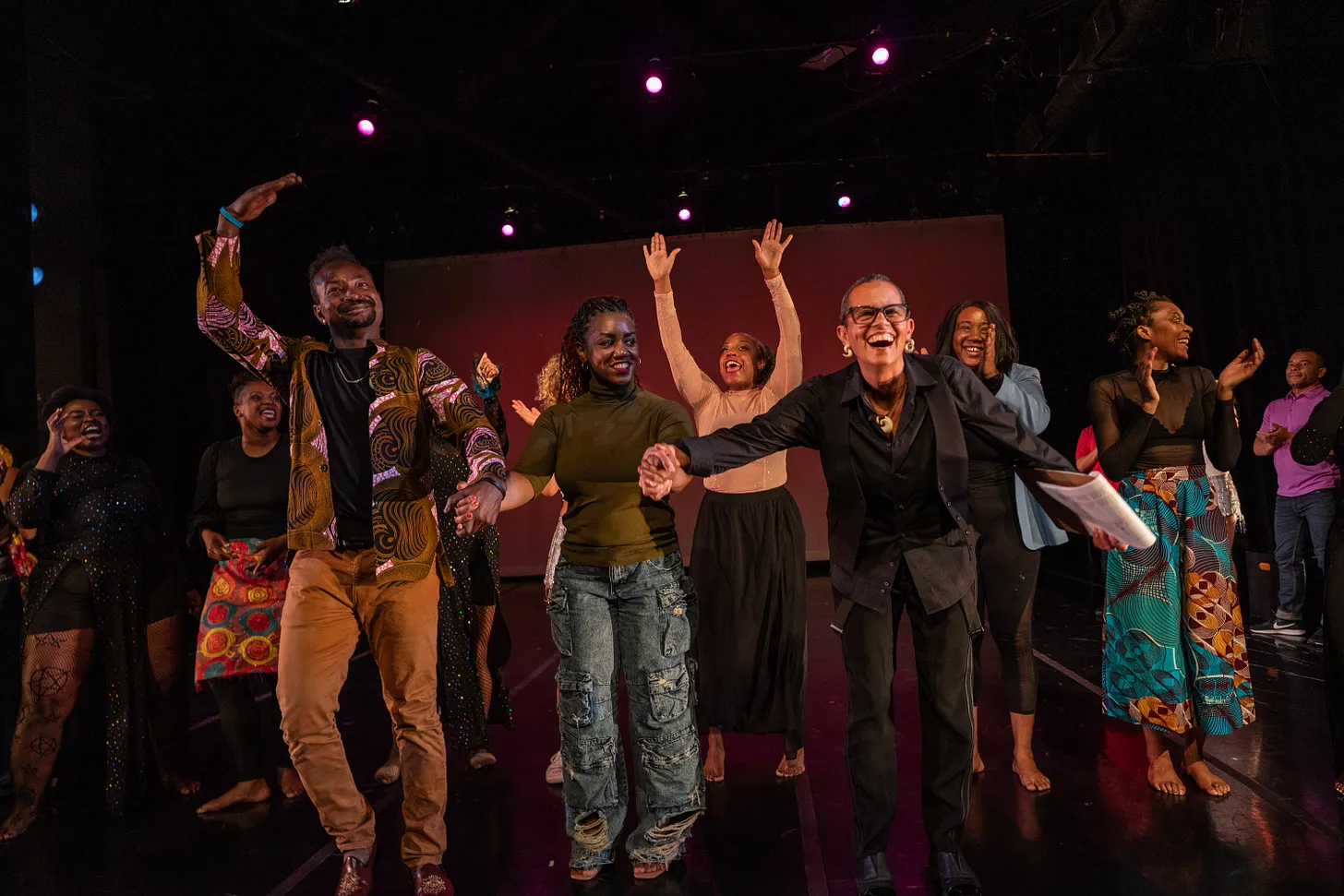
Sarah Crowell believes in abundance. This is readily apparent to anyone who has spent significant time in her presence. She radiates an infectious kind of joy, a creative vitality, that draws folks of all sorts towards her. This belief in abundance, and its accompanying action of holding the “energy of yes,” Sarah will tell you, has been a guiding light on what can be a challenging path as an artist, educator, and organizer in the dance community. Leaning into abundance seems to have helped her counter the narrative of lack that so often exists around the local arts ecosystem, and it has shaped her choices across a lifetime as an artist and creative guide. It led her to move out to San Francisco and join Dance Brigade, Krissy Keefer’s radical feminist dance company, over 35 years ago. It led her to co-found Destiny Arts Center in Oakland where she taught classes, started a youth company, and served as Artistic Director for 30 years. It led her to co-found the Belonging Resident Company, an intergenerational, devised dance and playback theater group exploring concepts of social belonging. It led her to co-found the Liberation Academy, now in its fourth successful year, as a way to uplift the “power of Black arts to create change.” It is, it seems, what led her to make her latest creative move – accepting the role of Artistic Director at Dance Mission Theater – a position that has only ever been held by her friend and mentor, Krissy Keefer, who founded the organization back in 1998.
Sarah Crowell is a phenomenon.
But don’t take my word for it.
Let’s get into the details of some of these stories so you can see for yourself…

Dancing with Dance Brigade: It’s 1989. Sarah’s belief in abundance has driven her and her then girlfriend to pack up their Honda Civic and literally drive from Boston, where Sarah had been dancing professionally, to San Francisco. It was a big leap but she had a vision. She was inspired to make the move after taking a workshop in Boston with Krissy Keefer and Dance Brigade. Dance Brigade’s work was exactly the combination of things that Sarah wanted from her art. It focused on “community building, co-creation, dance theater… it was spicy, funny, politically scathing, strong, and very honoring of women being gender fluid,” she recalls. She was hooked. She was determined to dance with the company. Within weeks of arriving in the Bay, and despite knowing very few folks in the city, Sarah had secured a solo audition with Krissy and Dance Brigade co-founder Nina Fichter. Krissy came and picked her up and they went to a dilapidated studio in the old Bay Guardian building. When, during the audition, the cassette tape with the music for her solo malfunctioned, Sarah was not deterred. Instead, she SANG THE SONG, accompanying herself through the jazz dance piece she had prepared. Krissy and Nina decided on the spot to hire Sarah as a touring member of the company. She was to make $80/month and start right away.
Sarah danced and toured with Dance Brigade for the next eight years and Krissy became a powerful mentor to Sarah and many others. Krissy modeled a choreographic process that was collaborative, bold, and driven towards making folks feel something. In an interview, Sarah recalled as an example the work the company did on “Pandora’s Box,”(1990). She was excited not just about the performance, but about the process that had led them there. The company read excerpts of Erich Neumann’s Great Mother: An Analysis of the Archteype, studying up on matriarchal cultures in order to inform the movement. In the original Greek mythology of Pandora, Pandora opening the forbidden box unleashes evil upon the world. In Dance Brigade’s version, this opening was a reclamation of feminine power. Sarah recalls, “Nina [Fichter] entered with a giant cobra around her neck, through a set piece constructed as a giant pussy. The dancers followed behind and were like these snakes writhing behind her.” When they took the piece to perform at the Southern Women’s Music Festival, Sarah recalls that at the end of the piece everyone was on their feet, “we got like a five min standing ovation, it was incredible.” She says, “…then I went back stage and and I just wept…” Life felt abundant and aligned.
Based on these sorts of experiences, and so many more in the intervening years, it is not surprising to those in the know that Sarah was recently tapped to take over as Artistic Director of Dance Mission Theater, Dance Brigade’s artistic home. (It was originally called Third Wave Dance Studio, and then Laurie Lewis Dance Studio, before hip-hop instructor Micaya came up with the Dance Mission Theater name). In an interview with both Krissy and Sarah, they noted that Sarah joining the team as AD feels like a ‘just right’ fit despite unsettling times. “I came back here because it just made sense. Dance Mission, Krissy, this is the model for the work I’ve been doing my whole career,” Sarah said.

Dance Mission Theater was started both to help pay the bills so that Dance Brigade could thrive, and to generate offerings of classes and performances, studio space and meeting space, training companies and choreographic opportunities, all of which would nurture a broader, engaged, dance community. Krissy has done it with such care that Sarah is not the only one on staff who has been involved with Krissy for decades. Karen Elliot who runs Dance Mission’s finances danced with Dance Brigade in some of the same years as did Sarah. Fredrika Keefer, Krissy’s daughter who runs Dance Brigade’s youth program, was a baby when Sarah was dancing with the company. Sarah recalls holding her and playing with her backstage before running out to dance her role. Grounded by this team, in this time, Sarah’s return represents what Krissy calls the next natural “concentric circle” of the organization’s growth. And, not for nothing, Sarah brings with her thirty years of AD experience at her own Destiny Arts Center – an impressive dance legacy that could not be more mission aligned.

Love. Care. Respect. Honor. Responsibility. Peace: Back in the early nineties, it was Krissy who encouraged Sarah to apply for a California Arts Council fellowship designed for arts educators in minority communities (**possibly a Minority Arts Development grant which was part of the CAC’s Multi-Cultural Arts Program starting in 1987, but this is not confirmed). It is this fellowship money that allowed Sarah to begin her journey as an arts educator, and eventually as co-founder of the venture she is most well-known for, Destiny Arts Center. She joined forces with Professor Coleen Gragen, offering stretch classes for adults at Coleen’s Hand 2 Hand Kajukenbo studio on San Pablo Ave in Oakland. Creative movement classes followed, and then Sarah joined up with Destiny co-founders Anthony Daniels and Kate Hobbs to create their own entity. In 1993 she created the Destiny Arts Youth Performance Company (DAYPC), which she says had “a Dance Brigade flavor, but with kids.” She notes that in DAYPC, learning moves became the vocabulary that the kids could use to talk about things that were important to them. They were guided by what they call the “Warrior’s Code” of “Love. Care. Respect. Honor. Responsibility. Peace.” Sarah and her collaborators fostered a particular blend of rigor and love in their students, teaching them not only how to be great dancers, but how to be thoughtful, engaged community members. She wanted the production values to be on point, to feel big, and the kids she served in the early days often didn’t have access to that kind of programming elsewhere (Destiny Arts still has a ‘no one turned away for lack of funds’ policy). She says, “I wanted to give kids in the hood academy level programming… It was like, I’m gonna push you, and expect a lot out of you, and I’m gonna love the hell out of you.” She created a performance ethos that said “yes” to rigorous training, but not the shaming that so often comes along with it.
Sarah’s legacy at Destiny Arts is epic. Destiny remains one of the Bay’s vitally important youth development organizations, serving thousands of Bay Area youth and families each year. They provide dance and martial arts instruction at their home site in North Oakland as well as at more than twenty Oakland schools. They also provide social services like youth counseling and a community food pantry. They have trained up teens through the Destiny Junior Company and DAYPC who have gone on to professional work in the field. Destiny has served as a second home and safe space for so many and, Sarah reports, under her leadership the company was always in the black – growing and thriving despite all different sorts of hard times, including the early days of trying to survive as a fledgling organization, the dot com bust in the early 00s, the effects of the housing crisis in 2008, right on up to the COVID pandemic in 2020.
It was Sarah’s passion and hard work, and that aforementioned belief in abundance, that made Destiny Arts possible. It was also Sarah’s welcoming way of working with others. When I asked her and Krissy about their ability to keep long term collaborators around Sarah said, “It’s about uplifting a whole community… people make mistakes but nobody gets canceled… people are folded back in and celebrated for their gifts.” She and Krissy share an interest and aptitude for dance that is also a form of storytelling, and the stories that they told through their respective companies inspired reflection as well as action. Year after year audiences would be on their feet at DAYPC shows the way that folks did for Sarah’s “Pandora’s Box” performance, and so she leaned in and made Destiny great. She kept making and building and, like Krissy, she has become a mentor and guide for so many who needed a safe place for artistic creation and expression.

Liberation and Belonging: When Sarah decided to step away from Destiny after thirty years, she did not plan to take on another AD role. She was ready for a new adventure, and trusted that Destiny was robust enough to survive without her daily presence (she continues to serve on the organization’s board). She felt in her gut it was time to make a move. She began doing consultant work for different entities, including the Othering and Belonging Institute (OBI), a social science research hub at UC Berkeley. Sarah has always been interested in “putting movement back in movements for social justice” and to this end she co-founded the Belonging Resident Company, a group of intergenerational artists interested in exploring OBI’s principles through co-created movement, storytelling, and playback theater. The company is ever evolving, drawing in folks with vastly varied performance backgrounds who are united by an interest in performance that is both rooted in life’s real experiences and dreaming towards a radically inclusive future. She also co-founded the Liberation Academy at Dance Mission, an endeavor that lifts up the power of Black arts and offers training and fellowship for Black-identified dance makers. Now in their fourth year of existence, the program is growing in popularity and scope with offerings including workshops given by Black luminaries, and an intensive track for BIPOC choreographers interested in making and presenting work in community. Krissy expressed hope that the Liberation Academy would become the guiding light for the whole of Dance Mission Theater in the years to come.
This may indeed be possible, since it was recently announced that Sarah and Dance Mission Theater are recipients of the Walter and Elise Haas Fund’s inaugural Creative Power Awards. The fund notes that the recipients “represent socially engaged individual artists, cultural practitioners, and community-based arts & culture organizations that make outstanding contributions to the Bay Area arts ecosystem… [the grant] frees artists and organizations to prioritize art-making and community-building without constraints.” In these times where funding for the arts is SO limited, this award is a testament to Sarah’s clarity of and commitment to certain ideals, as well as her ability to cultivate and captivate a community of collaborating partners.

What’s Next: Abundance. Abundance. Abundance. When I asked Sarah about her plans for Dance Mission moving forward she was clear. She doesn’t plan to come in announcing big changes, but rather to soak in the existing landscape, to show up at the shows, to listen to what the teaching artists have to say. Her goals as a leader here are the same goals she has for all her artistic endeavors – to use movement to build movements, to help create and uplift performance that effects meaningful change, to be in right relationship with folks in the Bay Area arts scene, and to foster what she calls “beloved community.”
As a creative director, she embodies the improvisational maxim of “yes and,” somehow affirming all the ideas folks throw into the creative mix (often with an exclaimed “that’s fire” and “let’s try it”), while simultaneously editing and shaping what’s offered into something cohesive and meaningful. No doubt she will bring this same energy to the new role, and that it will help elevate the good work that Dance Mission has already undertaken.
Dance Mission has an ambitious 2026 planned. They just announced their one million dollar “Thorns that Bloom” fundraising campaign. With great insight, Krissy and the other folks at Dance Mission foresaw that the best way to weather the storm of the current administration’s attack on the arts was to fundraise towards five years of financial solvency. You can help keep their programs, including Sarah’s Liberation Academy, the D.I.R.T. Festival for showcasing choreography, and their youth program Grrl Brigade, alive by donating HERE. Seriously, donate if you can.
Additionally, Dance Brigade celebrated its FIFTY YEARS of existence in 2025 with A Woman’s Song for Peace Tour. This year they are set to dazzle audiences with a world premiere of Match Girrl, which opens this weekend and runs from Jan 17- Feb 1 at Dance Mission Theater. The show is described as a “fractured fairytale about the American dream,” and is a creative reimagining of Hans Christian Anderson’s The Little Match Girl that only Krissy could dream up. It is set in a contemporary urban setting and grapples with drug abuse, the homelessness crisis, and the ever-expanding wealth gap in SF, in a deep, heartening, and even humorous way. No doubt Sarah Crowell will be in attendance, cheering them on, and chatting up the folks in the audience. Come by and experience the abundance.
* * *
Melissa Hudson Bell (she/her) is a dance nerd – she likes to create, and watch, and teach, and learn, and talk, and read, and dream about dance. She has an MFA in Experimental Choreography and a PhD in Critical Dance Studies, and has written about dance for numerous publications. She loves teaching dance to college students. When not engaged in dance things, she runs an Oakland-based media production company with her husband, and channels all her creative and logistic might into mothering her three vibrant, amazing kids. When she needs restoration, she heads to the ocean.