
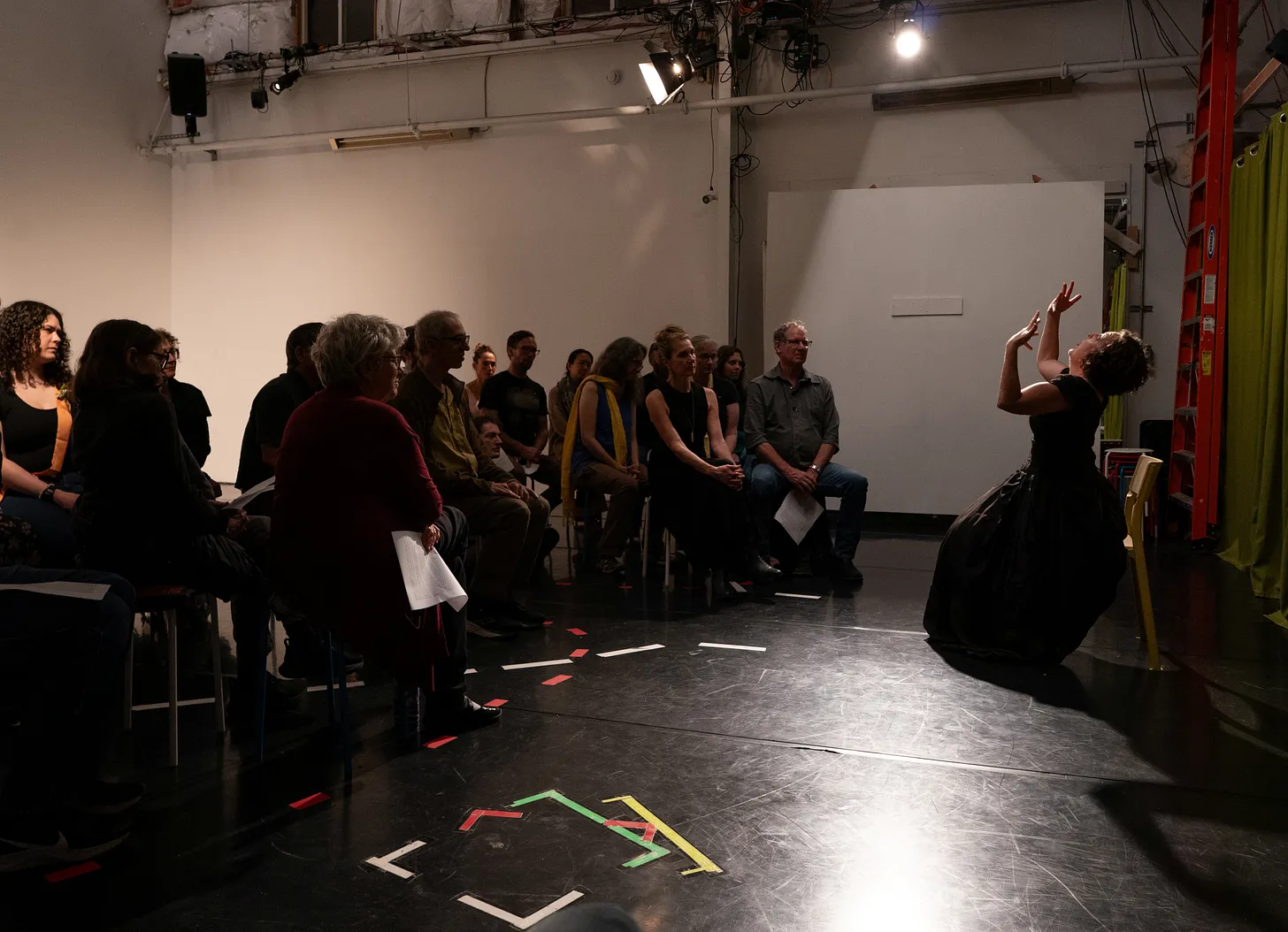
Mary Armentrout’s solo grappling with/haunted by what america+utopia might =, Photo by Robbie Sweeny.
“I see us doing good, impossible things…”
As I take my place on the small plastic stool with twenty or so other audience members I find myself thinking about the other times I have been to the Milkbar performance space in Richmond, CA. These visits include the following: a week long Feldenkrais and dance composition workshop, a multi-day dance research consortium, several solo rehearsal slots where I embarked on a meaningful duet with a wall, and an evening showcase where I performed a brief dance piece featuring my three kids and about eighty plastic jumping frogs. Each time I come here I find it simultaneously desolate and cozier than I expect it to be. This is fitting, I suppose, seeing as how it is a thoughtfully tended warehouse space nestled against a public storage facility, in an industrial area, near both a big oil refinery and a beautiful bay. When you enter the building, you venture down a short hallway, sidling past a dresser decorated by small knickknacks, and shelves heaving under the weight of an inordinate number of bowls, to a larger space that is simultaneously spacious and cluttered. It has a bathroom and stocked kitchenette on the left. Adjacent to the kitchen is an iron spiral staircase painted white, which leads up to a small loft with an office-like enclosure only barely visible from below. What is visible are the stacks of boxes the office seems to have burped up. They are pressed up against an opaque plastic covering that lines the wooden hand railing of the landing. Back down below there is an old piano (similarly strewn in knickknacks) and a collection of well-worn floor pillows and furniture, including a vivacious neon pink fuzzy armchair. I wonder about this armchair’s illustrious life before it took up residence here. Beyond this little living room set up, an assortment of stored items huddle conspiratorially against the wall, held at bay by a sentinel of ironing boards. An artist’s paradise. A door that exits out to a wildly overgrown cement patio beckons. A chartreuse curtain covers sound and lighting equipment. The obvious centerpiece of the room is a large dance floor, sprung and covered in black marley, with tall, white walls on two sides. About one third of the rear wall is covered by a mirror, which is mostly covered, most of the time, by a moving wall, or maybe I should call it a wall-on-wheels, which can be shifted about as needed. The ceiling here is very high, with big windows up near the top that allow natural light to cascade in. There is a DIY aesthetic common to many rehearsal spaces, more functional than aesthetic per se, inviting the viewer to call in a bit of imagination in order to transport us beyond the immediate confines of wood, metal, plaster, window.

I spend all this time describing the physical layout of the space because the performance itself makes use of many dimensions of the Milkbar, and includes a time-lapse video that takes us, at turbo speed, across approximately one full year in the space. Additionally, Mary Armentrout’s solo performance entitled, grappling with/haunted by what america+utopia might = calls one’s relationship to space and time to the fore through a centralized dancing figure, who we are introduced to as the “lady in the black dress.”

Images of the lady are where we start the show. She emerges upstairs from the office space, shifting in the light and darkness such that her full form is not yet fully visible. The lighting has been designed to cast large intermittent shadows of her on the wall, so she appears both larger than life and not fully materialized. Taking this a step further, as the lady descends and continues to waft about the space – around the kitchenette, through the living room set up, past the knickknacks, in and out of a closet – her visage gets projected on various surfaces including, charmingly, a lamp sitting atop the piano. The effect is one of haunting, for sure, and the projector choreography performed by Mary’s longtime creative collaborator, Erin Malley, is impressive.

The lady seems to exist outside of real time, though her meandering thoughts are squarely grounded in the room. “Yes, I can see you,” she says. At times we hear her disembodied voice but can’t actually see her at all. At times, we see her drift by, not fully grounded despite being anchored by bright red converse shoes. There is a sense, perhaps, that she is looking for something amidst these stacks of memories and partially-fulfilled projects. She moves not with urgency, but with a sort of off-kilter yearning. She exits out the door to the patio.

We move our stools, now facing the chartreuse colored curtain. She re-enters, citing the “thing” that must be discussed, and proceeds with what feels like one long perambulatory sentence, both in terms of actual spoken words as well as movement. She alludes to troubled democracy, hopeful visions for change, the uncertainty of “unfurling catastrophe” all around that she is sure we all feel, too. She sits in a chair, swoops to the side, swirls about one section of the audience. She speaks of composting, churning, making something new out of what’s been discarded. The lady in the black dress expresses concern, in a lilting sort of way, about what is coming that can be sensed and not yet really known. She has a Cheshire Cat sort of countenance and a Mad Hatteresque pre-occupation with time – “Who Are You?” combines with “Oh my, look at the time” to urge the audience, through direct address, to “fix” the “difficult thing” before it’s too late. “I can see us doing impossible, difficult, good things……” she implores, “can you see it too?” The run-on cadence and repetition of words within this segment, when coupled with the swaying, tilting, breezy nature of her movement, run counter to the surety of that statement. Does she believe what she is saying? Is she to be believed? In a time heavily laden with catastrophes of all sorts, is it folly or simply a survival tactic to believe in our capacity to do “good, impossible” things?

We the audience are asked to move again, this time to face the large white wall. Here the beseeching nature of the movement and countenance of the lady, as she is encountered in the flesh, dissolves into something more ethereal. We see her, and the space, cast into video created with and by Armentrout’s long-time collaborators, videographer Ian Winters and sound artist Merlin Coleman. The footage intersplices scenes of the lady in the black dress out in the world – in a field, on a dirt path, under a tree – with a timelapse video showing nearly a full year of days and nights, shadow and light, and humdrum human comings and goings from the Milkbar space. The lady’s voice lingers still, but here she enters as a phantasm, an illusory sort of presence that serves to amplify what comes into focus as the life of the space itself. I find my thoughts going to the land and its many manifestations, how it existed prior to the building of the Milkbar and the establishment of the surrounding roads and signs and swaths of concrete and steel. The video allows for time to be its own sort of presence, its own kind of haunting. Time that doesn’t stop. Time that is running out. Time that ticks by in this often empty space rather uneventfully, and yet constantly shifting. The change that creeps in at the periphery of our ability to notice it. The juxtaposition of the seeming solidity of the space itself, with the ceaseless tick tick ticking of the clock begs here for our attention. We are invited, for a few beautiful minutes, to deliberately sit with the complexity of our own temporality.

We take an intermission. A collective breath. A moment for co-mingling.
The second half of the show feels notably different from the first. It is less presentational, more like an experiential workshop that we didn’t know we’d signed up for. It calls upon the audience to participate in a series of tasks – dressing up as the lady, playing with projected light, sitting and holding hands in the dark. Armentrout goes from a focus on the lady as being both here and not here to a focus on her existing in multiple spaces, as multiple people, across time. It is suggested, through elaborate spoken text, that the lady is offered as a proxy for each of us as audience members, and as representative of complicated figures across time. Armentrout alludes to her own antebellum family history of being both Northern and Southern, working class and upper-middle class, migratory and inexorably White and American, by way of example. The tasks we are invited to participate in seem designed to foster a sense of belonging and community, but on this evening they are met mostly with reluctance. I see people glued to their stools despite the gentle, low stakes nature of the suggested tasks. People don’t seem terribly critical, but they are undoubtedly hesitant. I’m curious about it. Armentrout’s guidance is gentle and steady, almost meditative, with probing questions. ‘What ifs’ instead of urgent ‘let’s gos!’ Perhaps folks are ruminating, perhaps just shy? Perhaps they don’t want to be put in the spotlight? Perhaps they aren’t feeling connected to the task, or are they just waiting and wishing for someone else to start it? Does the hesitance belie an ethos wherein folks feel it is someone else’s job, but not their own, to answer the call to action? Might this be the sort of ‘grappling with’ the title of the work references?
Possibilities abound… and I find myself wondering how the hesitation is related to time – specifically to the ‘times’ we are living in. It is conceivable that folks have arrived here spent by the participatory demands of the unfurling catastrophes the narrative alludes to: a burning planet, eroding human rights, war, murder, fighting the very real threats of white supremacist ideals – all those things are calling us to action in real time. Maybe folks showed up just longing to be entertained. If so, the hesitance could be a sort of boundary setting, where folks are saying no in the interest of self-protection. It is too easy, it seems, to slink back and disassociate from both the tasks and the social implications the tasks propose here. What would it take to get folks off their stools? Could slipping on the black dress and absorbing what it offers, or grasping the hand of a stranger in the dark, help us rehearse what it takes to move, if not into utopia, at least out from under the farce of separatist “safety”?
The lady speaks of inhabiting a space of reverie that the audience, on this night, doesn’t seem to give itself permission to enjoy. I hear on other nights the audience allowed for more. Armentrout does not seem cowed by the awkwardness of tasks fractionally fulfilled, however. After all, she sees us doing “good, impossible things” even if we don’t yet put them in motion. At the very least, she has afforded us the space to “sit with” any hesitations that might arise, and to get curious about hesitation’s amalgamation.
Grappling with/haunted by what america+utopia might = will return to the Milkbar for a limited run in March before it, and the lady in the black dress, move on to haunt an old Victorian in small-town Michigan this summer. Take the time to go see for yourself what this sort of ‘being with’ offers you.
grappling with/haunted by what america+utopia might = March 5-7 and 12-14 at the Milkbar in Richmond. Tickets on Eventbrite: https://grapplingwith.eventbrite.com