
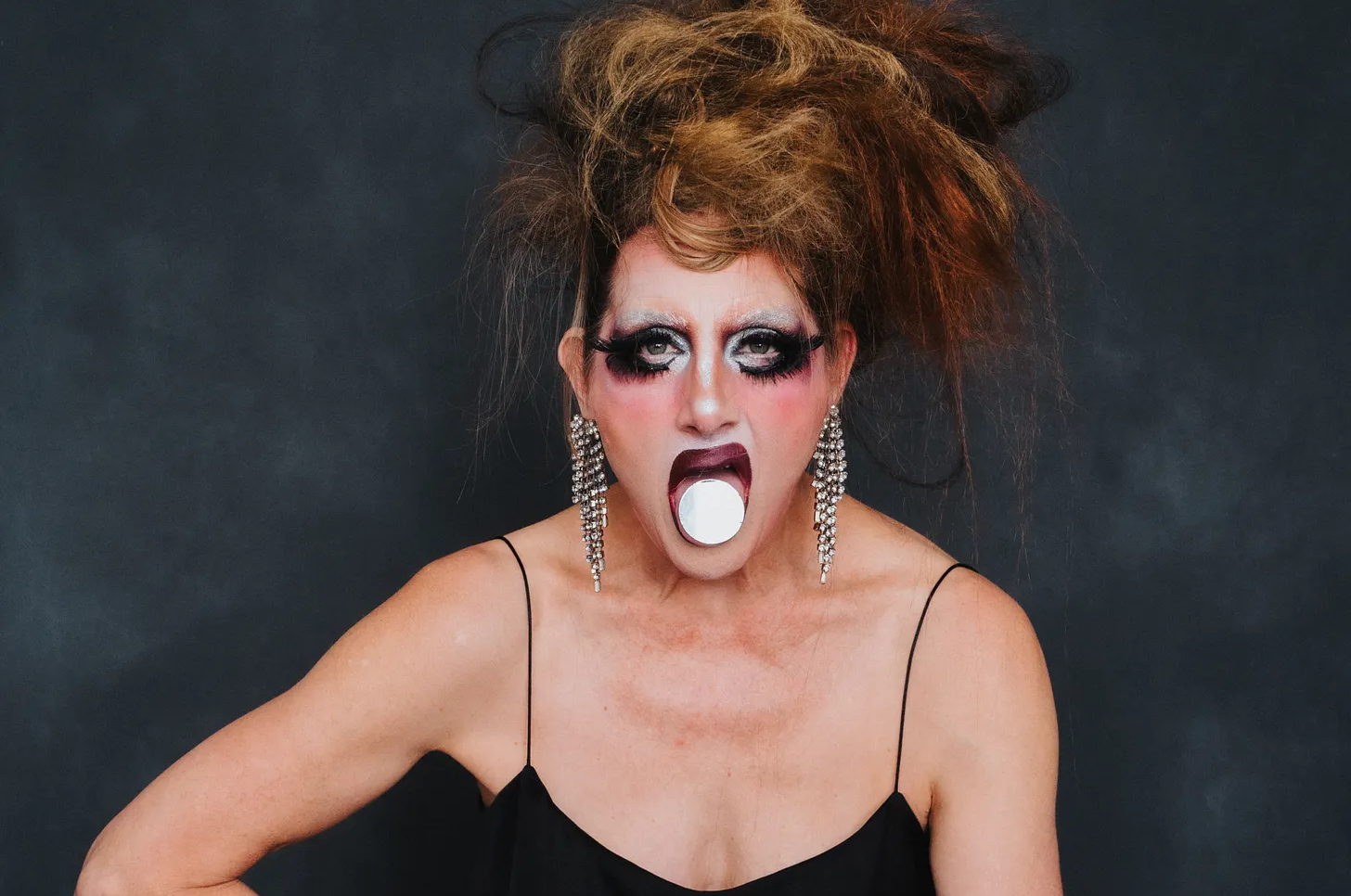
Fauxnique: How Do I Look? Publicity photo by Robbie Sweeny.
“How do I look?” a question that I’ve asked countless people over countless years of my life. I don’t know many people who identify as feminine who have escaped the seduction of asking this question. It’s equal parts insecure and enticing. It is, as Monique Jenkinson writes about in the promotional material for her upcoming show of the same name, “the most vain, mundane, and loaded question.” And yet, reading the title of this work, I immediately felt the longing my younger self had every time I asked that question. What was I longing for? Validation? Desirability? Sexual appeal? Attraction? Something else? What is the question actually about?
A few days before International Women’s Day, I spoke with Monique about the work, and we had a beautiful, meandering conversation about performance, femininity, identity, and queer theory. Chatting with Monique made me all the more excited to see the premiere of “How Do I Look?” at ODC Theater in San Francisco Friday, April 17th to Sunday, April 19th. The work is part retrospective, part dance, part drag, part roast, part stand-up routine, and part practice of liberation. It is an up close and personal look at Monique’s process of looking at the self, but perhaps more importantly, herself. In the work, Monique generates a world, bolstered by her work as a drag artist, that acts as an invitation for audiences to consider their own subjectivities, identities, and vulnerabilities enmeshed in their questions about perception as she reveals her own through humor and movement.
Part of Monique’s process is simultaneously digging into her artistic past–a past that includes ballet training, a love of fashion, postmodern improvisation, queer nightlife, and more–and her philosophical questions considering the practice of looking rising out of her desire to release the life-long concern about how others perceive her, asking the question: “How do we free ourselves of this?”
Freeing ourselves of thousands of years of men defining women is no easy feat. Aristotle in The Politics suggested that women are “female by virtue of a certain lack of qualities.” Thomas Aquinas referred to women as “imperfect men.” Even in this century, the president of the country makes vulgar comments about women’s bodies. But before we can be free of it, we have to ask: what does it mean to be a woman (or to practice femininity)?
Gender theorist Judith Butler, who was once Monique’s dance partner for Hope Mohr Dance’s 2017 Bridge Project “Radical Movements: Gender and Politics in Performance” tells us that our gender is our expressions and behaviours. It is, if you will bear with me, performative. Simone de Beauvoir wrote, some decades before Butler, that gender is something that we become, rather than something fundamental that we are (borrowing from the existentialist philosophical assertion that “existence precedes essence,” or we are shaped by our existence, rather than by preconceived categories). Unfortunately, it is a deeply ingrained notion for far too many people that the being of a man or a woman is an internal reality or something that is simply true about us, a fact about us that is assigned at the time of our birth and remains static and immovable for our lives. But actually, we could give ourselves much more space and grace if we could collectively understand gender as a phenomenon that is being produced and reproduced all the time, so to say gender is performative is to say that nobody really is a gender from the start. When we say gender is performed, we usually mean that we’ve taken on a role or we’re acting in some way and that our acting or our role-playing is crucial to the gender that we are and the gender that we present to the world.
So then, (let’s take a breath after all that philosophy!) femininity. Or, the feminine. “Femininity” is made up of the ensemble of cultural forms, meanings, and values conventionally associated with women (but not exclusively belonging to the category of “women”). Certain forms of adornment (dress and makeup) or personal qualities (passivity, mystery, sexual allure) have functioned traditionally as cultural markers of femininity. How do we find freedom in this?

As I sat down to write this essay, I was once again excited to see “How Do I Look?” but it made me think about my own uses of drag and desires to confront and interrogate femininity as I came into my queer identity. It doesn’t matter how many pussy hats are donned, how many pop stars proclaim that they are feminists, how many “binders full of women” are named to positions of power, we live in a culture that hates femininity, treats it as weak. Individually we may feel differently, but on a whole we live within structures of power that are inept at nurture and care, terrified of vulnerability and softness. To indulge in feminine culture is actually to be brave, and to have strength. And yet, we continue to see the devaluation of femininity play out, even in spaces that are meant to be inclusive, and queer, and radical. Monique subverts this, troubles these notions about femininity by taking an expansive approach to femininity, treating it as a space where we can play and joke and reinscribe from the heart.
More than that, perhaps, is the hope that we might heal some of the meaning-making that is imposed upon our bodies when we are perceived by those who can’t or do not want to understand what they are seeing. Are we able to, as Monique posed to me in our conversation, “get a break from relentless identity?” Have we crossed a threshold into overidentification? Have we disidentified ourselves into overidentification? Is the work of identity ever done or is it imperative that we be in continuous practices of disidentification/identification and abstraction/narrative? The stage, as José Esteban Muñoz proposes, is a site of possibility, an orienting device toward utopian elsewheres and otherwises. It is a place where we can tussle with these questions, even when answers are not guaranteed.
Something that always excites me about highly philosophical performance work is the way that an artist maneuvers humor. It seems so important that we be able to bring some lightness to thick, serious inquiries about our identities and vulnerabilities because laughter can grant access. Monique spoke with me about the self-roast part of the show, and said that it has the potential to “be a bit of a spell to liberate” because there is power in the roast to deal with the difficult stuff and even heal.
Near the end of our conversation, Monique jested “Would a man make a piece called How Do I Look?” and we both laughed. Of course not.
I am not alone in this, but I’ve spent so much of my life being told how and what to be. I’ve been told that femininity is a requirement for being a person in this body. And I can’t wait to see how Fauxnique unflinchingly (or perhaps flinchingly) grapples with these questions offering us, the viewer, new ways to see.