
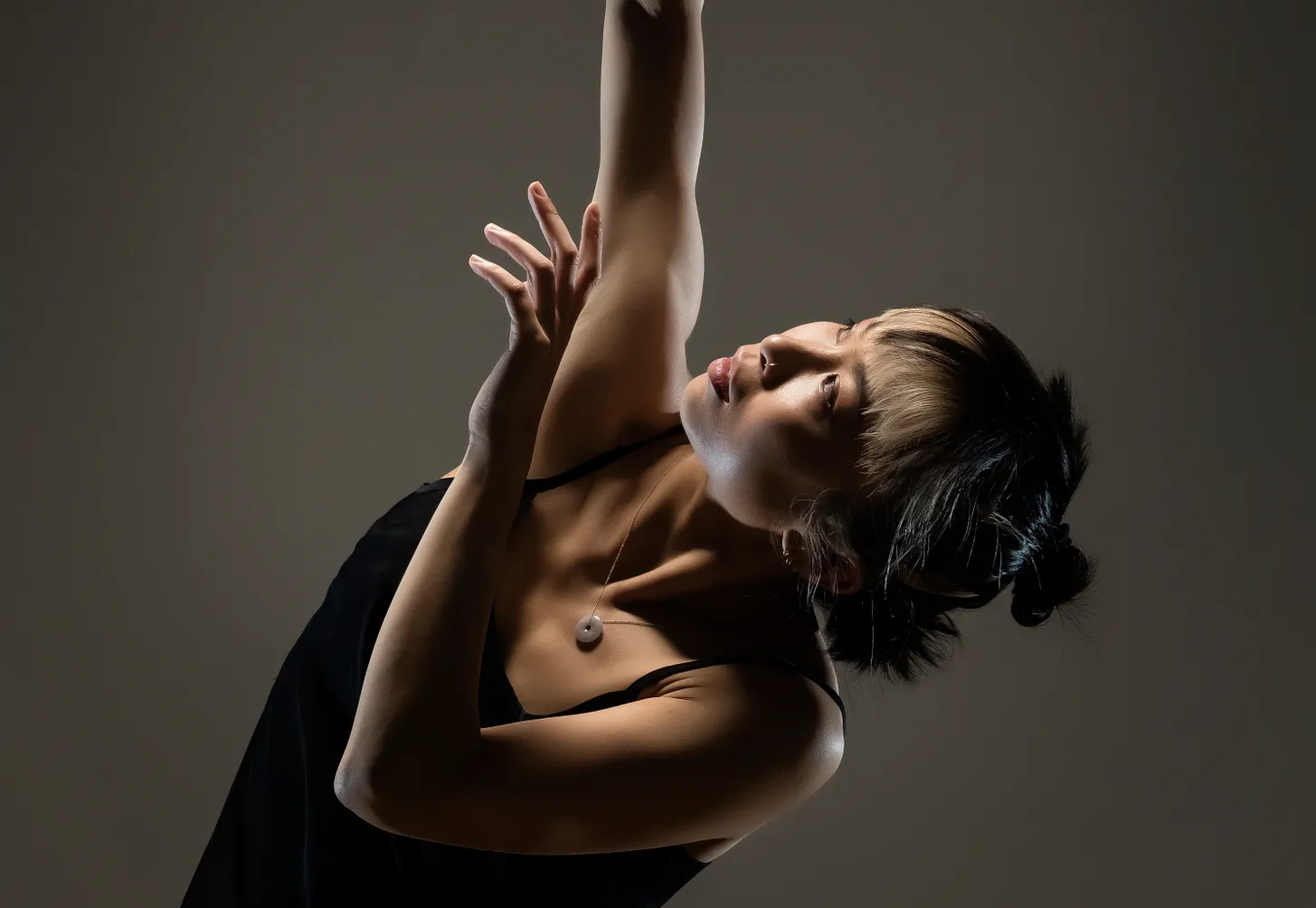
ODC Co-Artistic Director Mia J. Chong. Photo by RJ Muna.
“She just IS ODC,” says ODC dancer Rachel Furst on a Thursday afternoon in late January as we sit in Studio B during one of the company’s regularly scheduled rehearsals. She is speaking of her dear friend and ODC’s recent co-artistic director hire, Mia J. Chong. Mia and Rachel were both hired as dancers in the company in 2016 and have grown together as artists over the past ten years. “I am just so stoked for her. It feels like a perfect fit,” Rachel says of Mia’s new position. “It matters that she knows what it is like to be a dancer here. She has basically grown up in this building!”

I’ve come to see Mia in action. I have seen her perform in various roles for ODC and Robert Moses’ Kin across the years, and she is a stunning mover. But today I am more interested in seeing how she operates as a choreographer and director in this space where she began her dancing journey at age 5. Mia is comfortable and focused. She is welcoming to me, but clearly not catering to me. In fact, we barely speak. Her energy is directed entirely, as it should be, on the dancers and the task at hand. They are cleaning up some choreography for ODC’s upcoming Dance Downtown performances, which happen March 5-8, 2026 at the Blue Shield of California Theater at YBCA. Mia is remounting her first choreographic venture for the company called, “Theories of Time,” which they premiered last summer.
Over the course of about an hour I get to see the ODC dancers work and re-work a few sections of Mia’s choreography. It is intricate and layered, and indeed feels like a “just right” fit for the company. The vocabulary is visually interesting, with shifting couplings and trio partnering juxtaposed with standout solos. It is structural, almost architectural in its shapeliness, but not predictable, which I appreciate. Mia’s direction is clear and encouraging. The vibe is relaxed, but productive, not a hint of stress in the room. I notice that the energy in the studio matches the movement somehow – it is vibrant, congenial, responsive, focused. There is clearly a common movement language here, and a shared understanding of when things need to be worked out for timing and precision, and when they can be marked for spacing or sequence. Mia’s voice is quiet. She walks to where the dancers are working. She laughs with them. She gets on the floor with them. They engage in collective problem solving. Mia asks the nine dancers present to clean up a moment where they all run in from the side to begin a certain phrase. “Are we running in on the phrase or are we supposed to be there before it?” someone asks. “Hmm. Can we feel that out together?” Mia replies. They run it. They nail it. It is beautiful. “Easy peasy,” Mia declares, more than once. And these dancers really do make the dazzling look easy peasy.
Watching Mia at work, it is clear why she was tapped for this position. But, I wanted to learn more about her journey to get there so I had a Zoom interview with Mia and the company’s other artistic leaders, Brenda Way (who is the founder of ODC and Mia’s current Co-AD), and Kimi Okada (who is one of ODC’s original dancers, and has long been the company’s Associate Choreographer and the ODC School’s Director). Both Brenda and Kimi are effusive when it comes to Mia, who was drawn to ODC as a small child. ODC was one of the only places around to offer contemporary dance for children, and as Mia told me, she “did not want a tutu situation.” “I wanted to be able to roll around on the floor and stuff,” she says without apology. At age 7, Mia performed the title role in ODC’s Velveteen Rabbit, and reveled in her first experience dancing with professional dancers. As a teen she joined the Dance Jam, ODC’s youth contemporary company, where she was one of the group’s first student choreographers. “When Mia was eight years old she said ‘I am going to be the first ODC trained dancer to join the company’ – and she was,” Kimi recalls. “She lived and breathed our style. Our ethos. It was special.”

Mia began unofficially taking the company’s audition workshop before she was even eligible to join the company, at sixteen and seventeen years old. When she was nineteen, she officially auditioned and though she made it through several cuts, she didn’t get offered a job. She was invited to join as a guest artist, and then as an apprentice, before finally earning her spot as a full company dancer. There was no doubt Mia had the technical skill required for the company, but Brenda wanted to see her performance quality grow. Company dancers are asked to bring themselves fully to ODC’s work, not just to fulfill steps. They need to be able to “reach all the way through” to the audience, Brenda explains. In a very short amount of time, Mia’s skills in this regard were apparent and she enjoyed several seasons dancing and touring with the company. “They challenged me in all the right ways,” Mia says of the experience.
Mia, who is now 28, remains the only ODC trained dancer to have earned a spot in the company, which I was surprised to hear. The Dance Jam training program appears to be rigorous, and it is clearly consistent with the values and ethos of the ODC/Dance company. I assumed that part of the objective of the school might be to attract and groom dancers as potential company members, but that is not the case. With spots only rarely available within a ten person company, Mia had to maintain a certain sort of drive and vision to ensure that when a job came available she would be a contender. It is hard to secure a job dancing for a company – especially one like ODC that offers a 48 week paid contract with paid recuperation time. The ways that Mia has grown both within and outside of the company make it evident that she was an excellent choice.
Becoming a company dancer, of course, did not guarantee Mia was the first or only thought when Brenda and Kimi started to take action to ensure that ODC would continue on beyond their tenure. They began their search over a decade ago, bringing in several folks to work with the company whose artistry they admired. “We were trying on in our head, ‘what would this be like?’” Brenda recalls, acknowledging that the company, and the culture of the organization, could change in any number of ways with this decision. “I wanted someone I could get my shoulders behind,” Brenda says. After working hard for nearly fifty years to build not just the company, but the associated school, health clinic, and theater, it was clear that choosing someone who was passionate about both the artistry of the company and the mission of the organization was key. “It’s always been about building a dance world, not just a dance company,” Brenda asserts. “When we finally looked at the possibility of Mia – it became clear that she had the values. Others would be fantastic, but they didn’t have the passion for the big picture that Mia had.”

Mia’s passion for ODC meant that she was willing to leave it, when the time felt right, to gain experience she felt she needed to be an informed arts administrator and community leader. She completed a Bachelor of Arts in Social Sciences with a concentration in Organizational Behavior and Change from New York University in 2022, and in 2024 she received a Master of Science in Arts Administration and Cultural Entrepreneurship from Northeastern University. In 2023, Mia started her own contemporary dance company called EIGHT/MOVES, which is designed to create opportunity and camaraderie specifically for AAPI, BIPOC, and other marginalized artists. EIGHT/MOVES’ explicit mission is to “empower marginalized voices, bridge gaps between communities, and utilize the universal language of dance to generate social and cultural change.” Under Mia’s direction, EIGHT/MOVES dancers will be collaborating with ODC/Dance dancers for a piece this summer. It will be exciting to see how other opportunities for collaboration between the companies unfold.
It is true that, as a co-artistic director, Mia is stepping into a role not just as a leader in the company, but as someone who will be making critical decisions that affect the longevity of the organization, and by extension the dance ecosystem of the city. ODC/Dance, which famously began in the 1970s as a collective of folks selected and driven out here in a big yellow school bus from Ohio by Brenda, has always been both about training dancers and about building intentional artistic community. The dance world that Brenda and Kimi have made (along with former co-director KT Nelson and other long-time collaborators) is a major force within the SF dance world. The kinds of work ODC chooses to support, and how they choose to support it, has become rather influential in determining which choreographers and companies feel they can sustain an artistic life here. The vitality of the organization matters, as does its vision for the future. The fact that Mia, as a young woman of color with an explicit interest in dance as a vehicle for social and cultural change, will be part of this decision making matters quite a bit.
Fortunately for Mia and the rest of the staff at ODC, there are exciting things already in motion for the organization. Additional events in ODC/Dance’s 2025/26 Season include Path of Miracles at St. Joseph’s Arts Society, April 14 – 16; Dancing in the Park SF in Golden Gate Park, April 25; and Summer Sampler at ODC Theater, July 30 – August 2. Summer Sampler’s program will include two new works, the aforementioned collaboration choreographed by Mia and another by returning guest choreographer, Catherine Galasso. In terms of the school, there are plans to grow the senior dance program, which offers classes and discussions that are useful for elders, as well as to further develop the existing health and wellness program. ODC is literally expanding into a new and very spacious building adjacent to their existing theater. It will house staff offices and have additional studio space, and it also allows them to further build out the ODC theater lobby and backstage spaces. They envision the building as a sort of choreographic institute where folks at various stages of their dance careers can come together to share space, build their craft, and support one another. There will be meeting spaces and a costume shop, digital assets and desks for those in need of them, and, perhaps most importantly, a chance to interact and be inspired by other artists. Mia will be an integral part of all of this. “The school, theater, and company have really shaped my life’s path,” she says. “I realize that a central part of the mission is to support the full artistic life cycle… I really am a product of the world that they have built, and I’m glad to spend my time moving it forward.”