
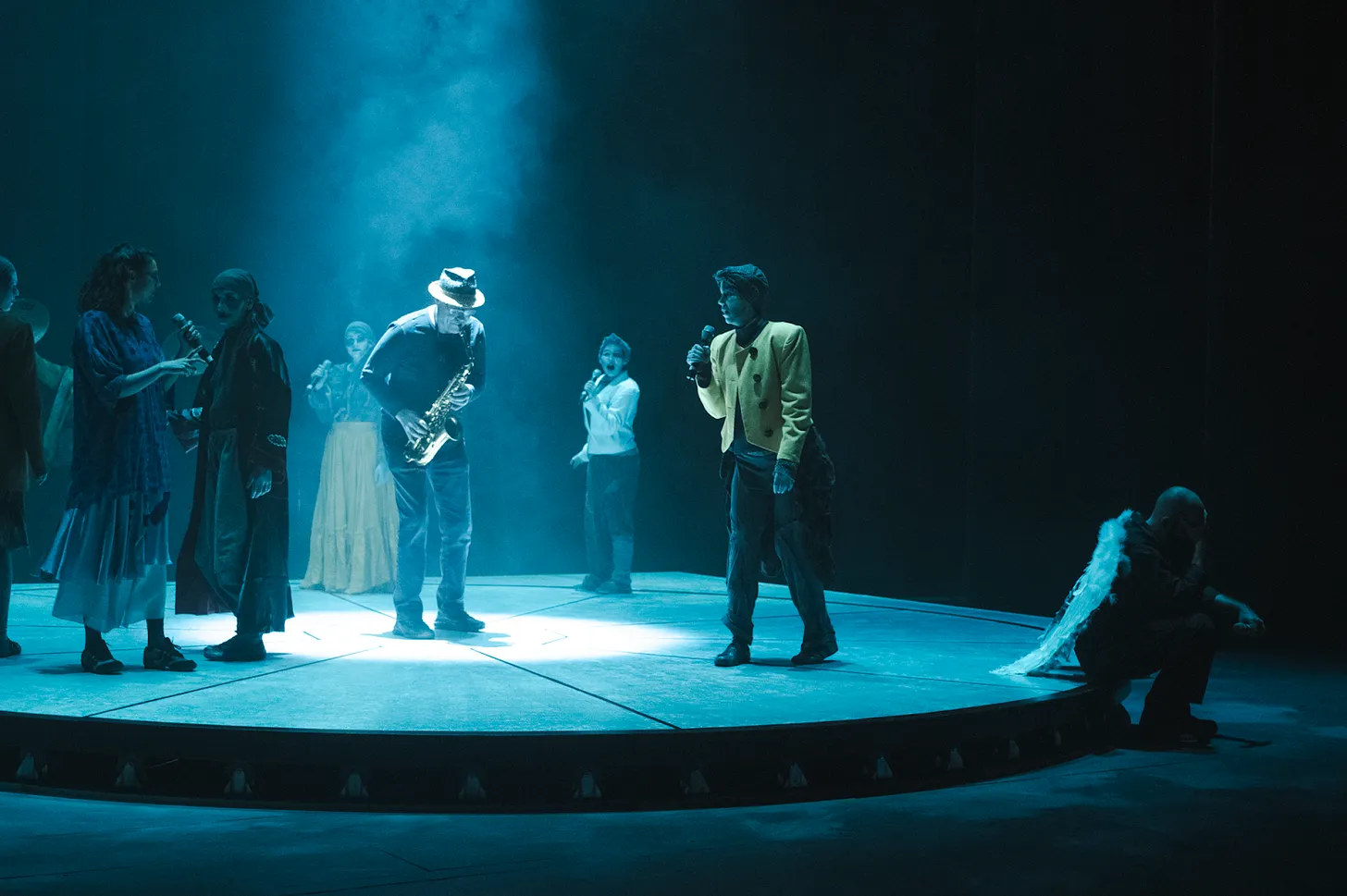
Jon Raskin on saxophone among UC Davis students in Phase 1 of “Clouds.” Photo by Shinichi Iova-Koga.
You can listen to this piece on Substack!
As a child, I played for hours alone in the woods, rapt with imagination, rocks and fallen trees. Unpredictably, I became a stage performer and director in my adult life.
Despite hermit-like tendencies, I depend on the challenges, inspirations and the experiences of others. The echo chamber of my mind becomes monotonous, a repeating litany, without the welcome addition of other voices.
Making theater work requires me to operate with others, to communicate and receive ideas, to practice swimming within a dynamic process; forming, re-forming, adapting. As individuals, we contribute to developing another world that none of us could manage alone.
“Clouds from a Crumbling Giant: our wild shining days” has been the project and laboratory within which I, along with a stellar group of collaborators, have played out the balance of the personal and the hidden workings of the universe since 2022. Each version responds to our context, changing with time and space. When asked for the ONE word that would describe this work, I answered “Polyphony” without really understanding what it meant. So I looked it up.
POLYPHONY
BBC MUSIC MAGAZINE defines the word polyphony: from the Greek for ‘many sounds.’ Polyphony describes the simultaneous use of two or more melodies (or voices) within a composition. This could be anything from a simple canon (or round) to something much more complex.
ELKE LUYTEN (“Clouds” collaborator): Polyphony—the many voices that are embodied in codified movement languages in our collaboration. As if we could think that we would not be codified at all. To me codification at this moment in time and in the world gives groundedness.
SHINICHI: inkBoat company works within a clear set of roles as part of our collaborative process. AND. We rotate perspectives and responsibilities. Though I act as Artistic Director, I ask others in our core group to change places with me. Like a relay race, who has the baton now? We work within a container that allows us to practice our skills both as performers and as artistic creators.
MARI OSANAI (“Clouds” collaborator): Inspired by the word “Polyphony” in Shinichi’s text, I offer a passage from Mr. Michizo Noguchi, founder of Noguchi Gymnastics:
Our bodies do not move uniformly and simultaneously. Rather, different parts move according to a natural order, forming a complex, subtle, multi-layered structure of tempo and rhythm.
Within the evolving “Clouds,” many themes emerge.
THE RISE AND FALL OF THOUGHT (AND EVERYTHING).
Initially, thinking into the nature of the universe, creation myths, the rise and fall of empire and the toll of war. As a Granada Artist in Residence, the University of California – Davis Department of Theater and Dance provided me the time, student performers and a high production value environment to begin the thought process. Cycles within cycles, the many voices becoming one and then fracturing out again. I had the support to dabble.
Allen Willner (Lighting Designer), Dan Cantrell (Music Composer), Suki O’Kane (Musician), Jon Raskin (Musician) and Edward Schocker (Musician) joined me and students at UC Davis (including Ann Dragich, who remains with us for the premiere). Some other perks: a rotating stage, a movable platform for the musicians and all the fog we wanted.

DANA IOVA-KOGA (collaborator and life partner with Shinichi): If someone who saw the very first iteration of “Clouds” at UC Davis in 2022 comes to see the premiere at Z Space (April 30 – May 3, 2026) they will see a very different show. And yet they will recognize it as the same organism that took its first breaths 4 years ago.

This 2022 video resembles a final production, rather than a beginning.
HEALTH OF THE COMMUNITY
“Do not take good health for granted. [Just as one] should not forget danger in times of peace, try to prevent the coming of disease beforehand.”
~Sun Simiao 7ᵗʰ century CE
“Life springs from sorrow and calamity and death from ease & pleasure.”
~Mencius 372-289 BCE
SHINICHI: We enact rituals for relating to each other, bringing our own lives in as the immaterial exchange. The rituals refine our relational skills. If I ask “what is health to me today?” the answer comes back: relationship. We ARE the relationship between ourselves and all other people, places and energies.
DANA: What if, instead of a private state of being, health refers to a context, a situation, a system, an ecology created from relationships? And what if it is the vitality of those relationships, the space between, that defines wellness? What if health is something to belong to? Seen in this way, many spaces come to mind where one might belong to health: a community, a network, a forest, a team, a village. Some of those spaces could be vast, such as a nation, others tiny in comparison. I want to ask, could a work of performance be one such tiny place?
SHINICHI: Our individual health rests in the health of the community, of the ecology around us. As individuals, we are as flames faltering in the breeze, dancing on the edge of life and death. If the fire weakens, small disturbances might extinguish it.
DANA: “Clouds from a Crumbling Giant” isn’t a show about health, though you will find the cycle of living and dying there, among other things. (If you listen carefully you will hear the recorded voices of elders in the sound score, and you may understand something about health from their vibrant voices.) I would argue that “Clouds” is health.
How it came to be such a space is due to the process Shinichi used to create the work and the source material we draw upon, as well as a testament to the beautiful natures of all the artists involved, from performers to musicians to designers.
One of my husband’s areas of particular brilliance is his ability to assemble creative communities for projects, and this piece might be his greatest work in this regard so far. What he does so well is to create conditions in which the talents of the collaborators have space to mingle and interact. He calls upon each artist’s singular expertise, he pays attention to what arises, he listens to ideas, he invites others to take turns to direct, he lets his mind and his vision evolve, based on what emerges. And he does all of this while keeping the integrity of the whole intact. What results is work that has the ability to be enormously adaptive, and yet remain true to itself. This is health.

SHINICHI: Intertwined with any concept, we practice to address the tangible body. One such practice is Tui Na, a medical manual therapy branch of Chinese Medicine which I have studied in-depth over the last year. Such a practice requires listening to, understanding and responding to another body through touch. It’s another entryway to our process. Back in November 2024, I asked David Wei of Wudang West, one of my teachers, to work with our group while we were in residence at BAMPFA.
Such practices are likely to be found in our two-day workshop on May 2 & 3. Glimpse Tui Na through this video: Tui Na workshop link
I have been fortunate to find myself in the company of such attuned performers/collaborators, some with extensive experience, some coming to the stage for the first time. We were joined in 2023 by Lebanese-Armenian vocalist and duduk woodwind player Khatchadour Khatchadourian. During that time, the clothes became the body that the soul occupies. When we arrive, when we depart, the community gathers to support the transition. The next video gives a glimpse of the warmth that can exist even in mourning: “Clouds” Phase 2 showing.
It feels weird to include money into the discussion of health, but it factors in. The artists give their time in a moment when many struggle to pay the bills. Most of us experience stress when the financial situation feels shaky. Bills, bills, bills.
Kazuo Ohno (one of the founders of Butoh Dance) would save and save all year so that he could pay for making a performance… rent the hall, do the advertising, endanger the livelihood of his family. Dancing on the edge.
We gather the money to struggle together, within a very particular frame or laboratory, hopefully with some amount of humor. We do this for ourselves, for each other and those who witness.
To struggle alone and stressed about money can feel desperate and forlorn. Unhealthy.
One month after our 2023 showing, my father died with almost nothing in his bank account and small cash bundles saved from his social security checks hidden in his sock drawer.
I wrote about this in a previous In Dance article, Preparing the Clouds
MOURNING THE OLD MAN
What role does grief play?
“Happiness is above the clouds
Happiness is above the sky
I look up as I walk
So that the tears do not fall
I cry as I walk
A night all alone
I recall that Autumn day
A night all alone
Sadness is in the shadow of the stars
Sadness is in the shadow of the moon”
~Kyu Sakamoto from “Ue o Muite” (aka: Sukiyaki)
DANA: When Shinichi’s father died, “Clouds” became spare, with plenty of room for his grief and memories of his father. When we had 100 sq. ft. to play in, the piece responded by becoming intimate and intricately detailed. When we had the luxury of a hall 20 times larger we brought in the moon. “Clouds” existed as a solo, twice as a duet, a few months ago it allowed us the extraordinary experience of having both our kids onstage with us as performers, it now includes a beautiful community of 34 artists. It is the same piece, simply reassembled to meet each new situation and each new opportunity. Again, this is health.
SHINICHI: Dan [Cantrell, composer] could empathize with me. He knew the emotions behind losing a parent. He has supported us as the primary music composer for every version of “Clouds.” When I went “solo” (which is never solo… for there is Dan backing me up, Dana offering her thoughts) I sought out a master Balinese mask maker, Cok Alit Artewan, who created three masks of my father, based on Balinese archetypes: as a young man, an old man, as spirit.


Many giants walked out of this world in the last few years. In 2021, Anna Halprin. In 2025 Koichi Tamano. And Ruth Zaporah, who joined us for a part of our BAMPFA “Clouds” residency. Just recently this year, Larry Reed, a Shadowmaster in the Balinese tradition.
Larry and I had a chat about mythology, art and change.
SHINICHI: I’m wondering about keeping alive the traditions, the source points… to refer to source points and have a modern relationship to them is one thing, but what if the source points aren’t there? …Certain things go down in frequency and I don’t know if they’ll disappear. And it might take hundreds of years, who knows.
LARRY REED: Or they get rediscovered… which happens kind of regularly. In Bali, there’s various kinds of instruments that drop out of use that come back again. And the use of the instruments. Gendèr (a type of metallophone used in Balinese and Javanese gamelan music), which used to be specialized just for cremations, tooth filing and Wayang (a traditional Javanese form of puppet theatre), has become this kid show where they have, instead of just two or four Gendèrs, they have six or eight. And these really young kids all decked out with jewels and stuff and they’re doing these very fancy things and playing really fancy music. It’s something that just happened in the last 10 years. So they keep evolving.”


THE BARDO
JUBILITH MOORE (“Clouds” collaborator): The Bardo of our creation is a boundless, enchanted and mysterious place. It is a theater of life and death experienced as a tragicomic jazzy romp across the realms of existence. Time is omnipresent but we walk backwards into the future, our lives on repeat, though never unfolding in quite the same way. On and on. It’s that kind of a world. In my time with inkBoat’s “Clouds: The Bardo,” Shinichi, Dana and I explored bringing together the central figures of a full Noh Cycle – god, warrior, woman, mad woman, demon and karma – or long-range cause and effect. What if, as Chiori says in her play This Lingering Life, “we are what we were and what we will be is what we are?” What if, karmically, one could be a warrior who, in their next life, is a woman who dozes off in the forest and then in the one afterwards a bucket-holding demon? When we are in the middle of living it’s impossible to believe we will die, and further that we could be anything other than what we are. We asked: what if we are all these figures, either in some sequence, or when in relationship to others? What if someone brings out our demon, or our old valiant warrior consumed with winning?
Adria Otte, “Clouds” sound designer, interviewed elders at Elder Ashram in Oakland, CA about their views on the afterlife. In this interview from 2023, elder Jyoti Amin had this to say:
JYOTI: What happens to you after death is the big question. Right?
ADRIA: So you think at least we are going back to nature?
JYOTI: Well, I mean the best I could say about incarnation is: dust to dust. I mean everything has a cycle. And we have this cycle… water cycle… so it’s everyone’s cycle. Alright.
ADRIA: We could finish right there because you know, you just spoke to the entire theme of this whole dance project. It’s all about cycles and we’ve come full cycle to that today.
JYOTI: Everything is a cycle.
ADRIA: It is. Um, well I don’t wanna keep you from lunch.
JYOTI: Well, it is time for lunch.
MARI: Suppose the sun’s center is a fixed point. What would the trajectory of my own lifetime look like? I drift upon the earth, and that earth drifts within the solar system… Exploring the drift within my own drifting body is my (Osanai Mari) dance. Tadayoi: the multi-layered structure of “drifting.”
How does this endeavor remain relevant to the context of the world, the events now?
“The ordinary is the extraordinary”
~Wang Xiang-Zhai (Qi Gong master) 1885-1963
ELKE: I am reminded of Tom citing Decroux often during our class: “Do something extraordinary with the ordinary, not something ordinary with the extraordinary.”
And a quote often said to us very young people in class: “We must do something between lunch and dinner.”
SHINICHI: This premiere at Z Space straddles “culmination” and “another step.” Once it becomes fixed, the project will die. Though it stands in a delicate balance within any moment, the moment constantly changes, allowing us to live in the act of balancing.
MARI: On the Meaning of “Standing,” an excerpt from the writings of Mr. Michizo Noguchi, inspired by the stage art of Shinichi’s work.
To stand means for something to become what it inherently is. … For something to become what it should be, to exist in a manner befitting itself—that is standing.
Everything existing on Earth can only exist by connecting to the Earth’s center through its own weight, thought…Cherish the single point on Earth where you stand now above all else, connecting through weight.