
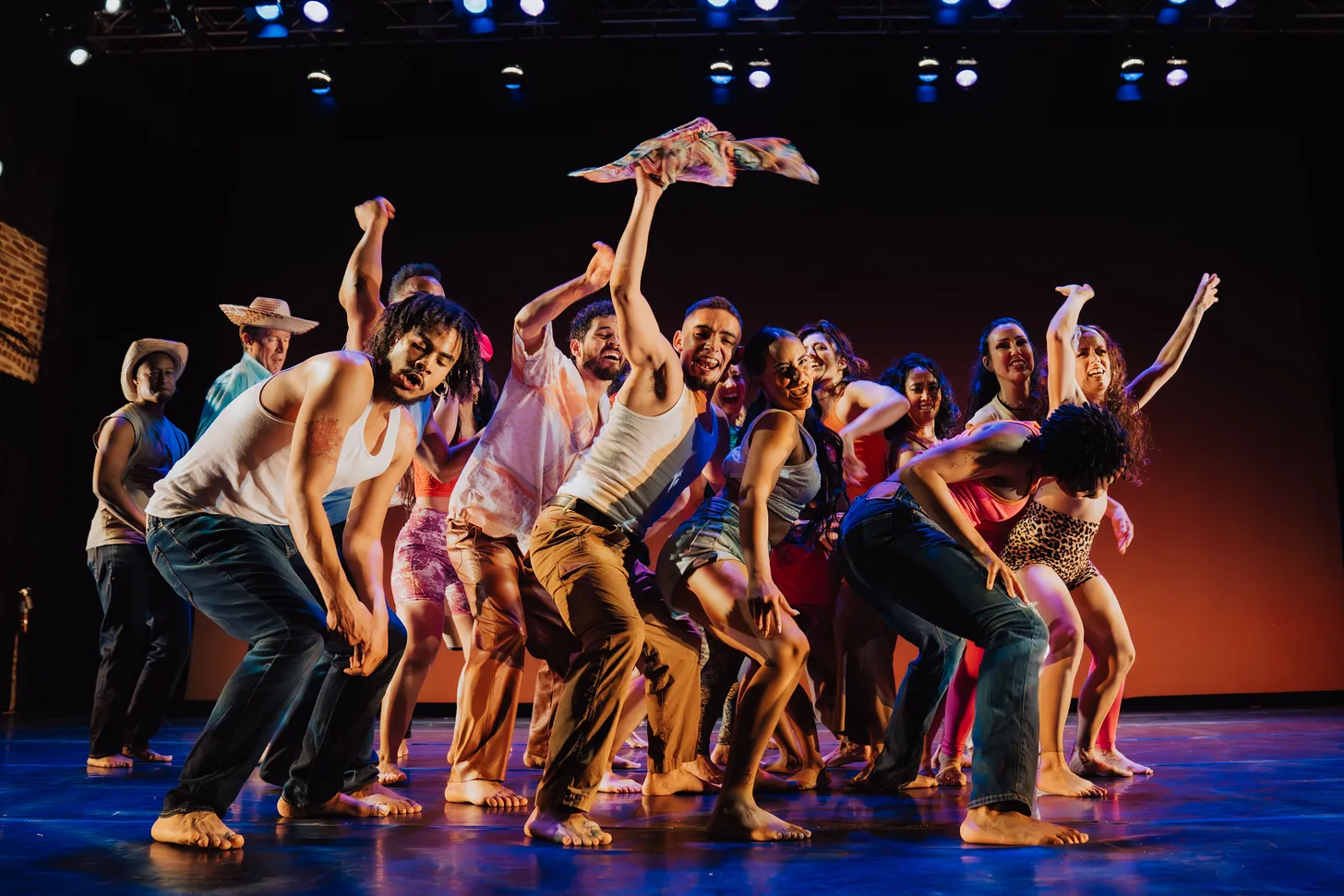
Alayo Dance Company in CubaCaribe 2024. Photo by LexMex.
As the lights dim inside the theater and the audience settles, two figures step into the spotlight: Ramón Ramos Alayo, a towering figure whose long-locked hair falls lightly against his freshly pressed pink dress shirt, and Jamaica Itule Simmons, a curvy brunette wearing a stunning tropical floral print dress and red patent leather heels. They welcome us to the opening night presentation of the CubaCaribe Festival of Dance and Music.
As they speak, behind them in the dark, drummers and singers file in and take their places while dancers wait in the wings. When Ramón and Jamaica leave us, a flush of warm theatrical lights fills the stage as an electrifying wave of folkloric Cuban music ignites the hall. The drums’ heartbeats touch our own, synchronizing us all into a swell of artistry, as costumed bodies move rhythmically to the percussive music.
Seven more acts follow by Bay Area dance companies representing countries that hug the Caribbean Sea – Peru, Mexico, Haiti, Columbia, Puerto Rico, and Cuba. Few could ever physically travel to all of these places but this night, inside the walls of the ODC Theater at the CubaCaribe Festival, we are transported, we pay witness, and feel every note, every sway, jump, bend, stomp, and twirl that emerged from lands that touch those warm waters. This gift to audiences by CubaCaribe is a tradition the SF Bay Area has enjoyed for twenty years.
Indeed, the CubaCaribe Festival is celebrating its anniversary, its twenty years of brilliance. Their work has been speaking to the root of a culture and a people who have survived centuries of oppression, decades of a debilitating trade blockade, whose creativity thrives despite and because of its challenges, and who refuses to be erased.

Cuba, in this very moment, is experiencing a humanitarian crisis because of a US fuel blockade unlike any we’ve ever seen. It is difficult to celebrate anything given the current painful moment. And yet necessary to the very essential endeavor of the arts – to see, to be seen, and give meaning to our humanity.
Ramón Ramos Alayo, CubaCaribe’s Artistic Director, a spectacularly well-trained Afro-Cuban modern dancer, arrived in the United States from Cuba twenty-five years ago and worked for famed San Francisco-based choreographer Robert Moses. Ramón had benefited from a boarding arts conservatory since the age of ten that trained him in high-level ballet, modern, and jazz, while concurrently, in all of Cuba’s traditional folklore dances. He picked up the richness of salsa and timba dance in almost every public and private space throughout his hometown of Santiago de Cuba. He was raised in a culture that is arguably unmatched among any Latin American country that values creativity and the arts in such an extraordinary way despite the scarcity. In Cuba it is said, el baile es vida, dance is life.
On a trip home from college to Arizona, Jamaica Itule Simmons, CubaCaribe’s Executive Director, attended a Cuban dance workshop to which her aunt invited her. She was “immediately transfixed by the soul and beauty of it.” She knew she wanted to learn all of the dance forms; she knew she wanted to follow the music. While in graduate school in the Bay Area, Jamaica auditioned for and danced in a show called Mis Sueños, Mis Ideas choreographed by Ramón at Dance Mission Theater. Soon after, they came together to dream up ways to create more shows like this. Jamaica noted, “There were a lot of immigrant master artists trained in Cuba who were living here. There was a momentum, an energy, a feeling to be explored, a need for people to experience Cuban dance in the Bay Area.”

The duo turned for advice to Robert Moses, Sylvia Sherman of La Peña and Community Music Center, Krissy Keefer of Dance Mission, and Eduardo Rivero-Walker the director of Teatro de la danza del Caribe de Santiago, the professional dance company Ramón danced with back home in Cuba. They urged Jamaica and Ramón to follow the dream to build this unique organization because they too saw and understood the importance of sharing this work.
It was something nobody else was doing at the time.
They mentored them and gave them advice on the technical aspects of creating their first performances. But also, there were the artists and aficionados, the dancers and musicians whose input and energy Jamaica recalls, “sometimes gathered around the kitchen table, contributed to our communal beginning.”
As Ramón and Jamaica began to build, Ramón recalls, “we could not bring people directly from Cuba because of the embargo. African culture came to Latin America through Cuba and it was the touch point to the rest of the diaspora in the Caribe and into the US.” Ramón also credits the Ethnic Dance Festival as a model, though they had a different focus. Ramón was most deeply inspired by the Festival del Caribe – an impressive multi-day, multi-disciplinary arts festival in Santiago de Cuba which invites countries from across the Caribbean to perform and which always features one of the participating countries. Ramón says it was so influential, this festival taught them to reach beyond Cuba, “to make a connection with el Caribe.”
In the spring of 2005, they collaborated with Krissy and Dance Mission Theater and launched the first CubaCaribe Festival. Though they learned many lessons, the festival was so successful, they were hooked. Since then, with the same innovative and resilient spirit present in Cuba, they’ve worked tirelessly every year to grow that initial spark into something more expansive and far-reaching than they ever expected.

What they started has grown in depth and includes two and up to three weekends of dance performances, film screenings, lectures, photo exhibitions, master workshops, and dance parties. Using venues primarily in San Francisco but also extending out to the East Bay, the shining mixed performances are usually sold out to enthusiastic audiences. One of their top priorities has been to offer programming that is professional in every aspect – from ensuring each group authentically represents their country, to presenting in venues that honor and respect the dancers and musicians, to producing breathtaking photographs of the dancers, to striving to make the production value aim higher than the year before. These high standards are part of what has kept audiences and their collaborators coming back for more.
An element that is unique to the CubaCaribe Festival, is their offering a beautiful balance between honoring roots dance but also being in the vanguard in developing and elevating new work.
One weekend of each festival is dedicated to a specialty project. Consistently, the specialty project spot has been a canvas for Ramón’s own Alayo Dance Company who specializes in Afro-Cuban modern and who has created deeply poetic and personal works based in storytelling. He uses Afro-Cuban culture as a definitive foundation, in maintaining what he calls “la esencia” but then redesigns and re-imagines its shapes, its architecture, its movements and sounds through dancers who are equally adept in the traditional and in the modern. This esencia is a mix of all the cultural, secular, and religious practices present in Cuba and from which he draws “the undulations, the gyrations, the jumps.”
One of the most meaningful pieces Ramón presented with Alayo was entitled, Blood and Sugar. “I created that story based on the enslavement in Cuba… why Africans were brought to the country to cut cane… and what happens in Cuba beyond that point.”
Ramón has depended on special project grants to fund Alayo Dance Company’s CubaCaribe participation. “Everyday things are more difficult for us. We are losing the value in the arts. There is less support. There are so many ideas I’d like to mount but can’t because of questions of funding.”
Jamaica, a dancer and talented visual artist with a BA in art and MFA in graphic design, has also brought her own artistic brushstrokes to the festival’s offerings, as a dancer and choreographer, suggesting festival themes or new companies on the horizon. However, it has been in navigating the non-profit’s business as a skilled grant writer, logistics expert, and executive director, where she has excelled. Her ability and creativity to run the organization, like Ramón’s, seems inexhaustible.
Financing the festival is perhaps where the biggest challenges have been for the organization. They started being fiscally sponsored by Dance Mission and then eventually took the steps to become their own non-profit. They’ve presented on a shoestring budget relying on all manner of fundraising tactics – filling seats, selling concessions, family loans, local and national grants, individual sponsorships, hosting fundraisers including a yearly gala complete with dinner, show, and dance.
Their spirit of resilience and ingenuity to survive in a changing arts environment with diminishing financial support is a mirror to that of Cuba’s spirit in each of their efforts. “Now is an uncertain time because of what’s going on in the world and in the country. Saying that though, arts organizations have an incredible ability to adapt. Artists often get to work when things are toughest,” affirms the unshakable Jamaica.
CubaCaribe’s festival programming over the years has given both Ramón and Jamaica a treasure trove of unforgettable memories. Jamaica speaks about how “every year at the festival before the show starts, we circle up backstage with all the artists and some of our staff and volunteers. It’s a huge circle and we create a beautiful sacred space. We often say a few words as do the artistic directors of the companies performing. That’s when I feel the proudest. Together in that space, being still for a moment, and realizing that sacredness can happen. There is something so magical about bringing people together for live performances.”

They both hold one memory as a pinnacle of CubaCaribe’s work. In 2013, CubaCaribe brought Teatro de la danza del Caribe de Santiago, Ramón’s former dance company from Santiago de Cuba for a collaboration with Alayo Dance Company. Jamaica recalls “The dancing was spectacular. The dancers were so well trained. It was just ‘next level’ of art.” For Ramón, it was both a full circle moment and also bittersweet because the director and his mentor, Eduardo Rivero-Walker, passed away six months before the company came to the States. Ramon fondly remembers, “The name of the [Afro Cuban modern] piece was The Professor and the Disciple. The idea was for him to come here and see all that I had achieved as a dancer and choreographer, to collaborate with my dancers, and for us to share his work with audiences here.” That performance was historic not only for its high level of artistry but because it was only one of the two times they were able to bring companies from Cuba in twenty years. Jamaica says, “everything had to come together in a perfect collision—politically, financially, logistically—for it to happen. It was awesome.” Luckily, Alayo dancers were able to go to Cuba to perform and do a real cultural exchange with Danza’s dancers before Rivero-Walker’s passing and so he did see some of Ramón’s gorgeous work.

This year, the 20th Annual CubaCaribe Festival of Dance and Music is a celebratory retrospective of the last twenty years of moving forward in community, resistance, and joy. With the theme Mirando Atras, Moviendo Pa’lante / Looking Back, Moving Forward, this anniversary season features seven dance companies performing and participating in community engagement and educational outreach activities over the course of the festival’s fourteen days – from April 8 -19. A special highlight of the festival is an April 8th lecture demonstration by master percussionist and internationally renowned seven-time Grammy® nominee John Santos, who will be honored by CubaCaribe in a pre-show event on April 12th.
On its first weekend (April 10-12) the festival will feature six diverse pieces by acclaimed Bay Area Caribbean and Latinx performing artists and their companies, chosen by Ramón for their artistry and impact from past festival performances over the last twenty years. Many will be accompanied by live music performed by ensembles of master instrumentalists and vocalists. The companies include Alayo Dance Company (Afro-Cuban Modern; Artistic Director, Ramón Ramos Alayo), Arenas Dance Company (Afro-Cuban Folkloric; Artistic Director Susana Arenas Pedroso), Los Lupeños de San José (Mexican Folkloric; Artistic Director Samuel Cortez), Cunamacué (Afro-Peruvian; Artistic Director Carmen Roman), Alafia Dance Ensemble (Afro-Haitian; Artistic Director Mariella Morales) and Juntos (Cuban Youth Ensemble).

The second weekend on April 17-18th, entitled, Enraizando/ Rooting Within features work by Shefali Shah and Aguacero. This special evening length performance highlights the transitional experience and journey of young women facing womanhood through Puerto Rican Bomba music and dance. Shah explains, “As women we are often forced early on to ignore or hide the more vulnerable parts of our stories in order to endure a world that dispossesses us of our essence through patriarchal and racist violence.” She adds, “Through Enraizar, young women of color challenge this by telling stories that show how they go within and embrace their vulnerabilities.”
Commissioned by CubaCaribe with support from the Gerbode and Rainin Foundation, Enraizando is a major multi-year, multi-generational project, involving teen and young adult dancers alongside the professionals of Aguacero. Shefali Shah, who was born and raised in Puerto Rico but has lived in the Bay for many years, is an exquisite dancer of the Bomba tradition, her dynamic dancing is unique within the dance form. When Jamaica told her they received the Gerbode Foundation grant, Shefali was “so honored that CubaCaribe had entrusted me to build on the project I had already started with the youth and bring it to the festival stage.” Since then, Enraizando has blossomed. Shefali brought in a wide array of musicians and dancers, as well as award-winning filmmaker and photographer, Eli Jacobs Fantauzzi, to document their journey as well as provide video images to accompany the performance. Through additional fundraising, the group recently traveled to Puerto Rico to deepen their knowledge and understanding of Bomba and themselves. “We’ve all worked incredibly hard. It’s been exhausting but so worthwhile.” It promises to be an incredibly powerful offering at the festival, a night not to be missed.
The CubaCaribe Festival has held a collective of cultural bearers, their spirit and vision, stretching from Cuba and the Caribbean across the American continent to the SF Bay Area. It has held up artists, resilient resisters, those who archive culture and history, those who innovate and dream, those who dance and sing to be seen and remembered. The art is boundless and is meant for sharing, for leaning into the heart space, like the beating of drums, so that we come to understand the humans and cultures who created it. After twenty years, CubaCaribe shines with the ever-present hope that the brilliance of the arts will tear down our differences, will bring us together in their light, and with the hope, as Ramón says, “CubaCaribe never dies but lives on.”