
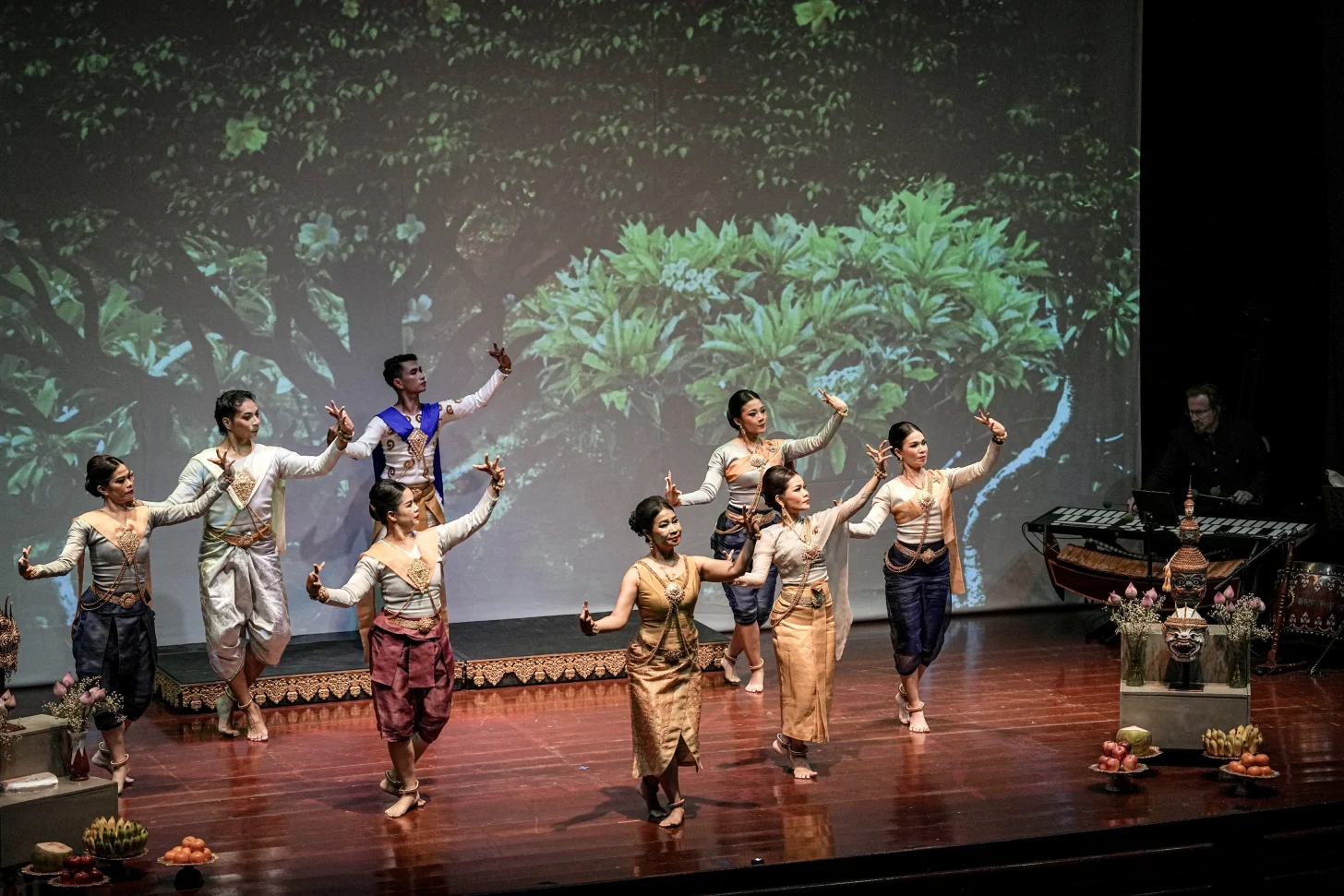
The Rebirth of Apsara created by Charya Burt at Chenla Theatre in Phnom Penh, Cambodia, 2025. ACT III dance scene “Robam Donvaay.” The photo shows the dancers moving together in a traditional dance gesture (cheep – a bud of a flower) to symbolize how the dance has been progressing following the Cambodian genocide. Dancers (left to right): Phirom Sao, Chakra Sokhomsan, Srey Leak Rin, Rady Nget, Charya Burt, Molyta Pum, Hannah Chea, Chantheary Long. Photo courtesy of Charya Burt.
I first met Charya Burt in the late 1990s while serving as the Artistic Director of Asian American Dance Performances from 1992-2004. During that time, I had the opportunity to meet and present modern dance choreographers as well as folk and classical dancers from the Asian diaspora. Some teachers were very strict about not letting any part of the dance change. They were able to, over decades, maintain the integrity of a specific dance form. What I found interesting was that periodically, an artist would travel back to their homeland to discover that the dances had changed. Dance is a living art form passed down from generation to generation by evolving communities, and therefore traditions thought to be fixed, change.
Simultaneously, dance is a way to preserve the heart of a culture; its values and unique characteristics. The arts are an important part of cultural preservation, especially in the face of erasure, oppression, and genocide.
From 1975–1979 the reign of terror and civil war took the lives of over 2 million people in Cambodia. They died by execution, starvation, or exhaustion from forced labor. Cambodians lost one out of every four people during the Khmer Rouge leaving in its wake a legacy of trauma. With most cultural documents destroyed and with artists and scholars targeted – over 90 percent of them killed – it was up to a handful of surviving dance masters and academics to resurrect Khmer art and culture from the ashes. Charya, who lost her father and two brothers in the genocide, was inspired to learn classical dance while living with her uncle, Chheng Phon, who established a performing arts school following the fall of the Khmer Rouge. He would later go on to be Cambodia’s Minister of Culture during the 1980s, credited more than anyone for the revival of the arts. Charya lived and trained at the School of Fine Arts, an institution that would later become the Royal University of Fine Arts, where she would eventually teach. It was here that she studied daily with the surviving dance masters to learn sacred dances, including the 4000+ gestures that make up the vocabulary of classical dance.

Charya Burt, known as Neak Kru (teacher) to her students, came to the United States in 1993. Over the past 30 years, Charya has been a keeper and cultivator of Khmer culture and dance, travelling from the North to South Bay performing and teaching. The Rebirth of Apsara premiered in 2024 in partnership with New Performance Traditions after Charya received a Hewlett 50 Arts Commission. The Rebirth of Apsara is a full-length work that explores how Apsaras – female celestial beings – have embodied the essence of Cambodian culture from ancient mythology to its post genocide resurrection. Charya and her husband Rob Burt developed the work in collaboration with both American and Khmer artists across disciplines and countries with much of the work happening in Phnom Penh between 2022 and 2023. A new adaptation was created in 2025 to observe the 50th Anniversary of the beginning of the Khmer Rouge Genocide. During the creative process, Charya conducted residencies in cities with significant Khmer populations in the United States including Oakland, Long Beach and Stockton, California, along with Chicago, Illinois and Lowell, Massachusetts.
I marveled at how cultural workers and artists will always be part of the preservation of memory and cultural legacy. They serve as healers as we attempt to make sense of the world and our place in it.
Each residency provided an opportunity for students from the area to work alongside their Neak Kru Charya, shedding light on their shared experiences associated with this traumatic period, and celebrating the beauty and resilience of the Khmer people. The work is a unique blend of artistic disciplines involving dance, theater, music,video design, and personal story. As a modern art work, The Rebirth of Apsara is experienced uniquely by each audience member, allowing them opportunities to choose where to focus, including on the dancers, the musicians, the sound scape, the text, the altars in the space, and the imagery projected. As a modern piece, it also provides space for the audience to examine their own thoughts and memories. This monumental project culminated in an unprecedented performance in Cambodia. Charya’s work The Rebirth of Apsara, directed by Rob Burt in Phnom Penh, was meant as a love letter to Khmer Culture.

I had the opportunity to travel to Cambodia to join my husband, Joel Davel, who served as the Musical Director to The Rebirth of Apsara.
The company was in full swing of putting together the international cast. When I arrived, a week after they started rehearsing, I found them in the YK Art House, a gallery in Phnom Penh. While watching their run-through about rebuilding culture after a legacy of genocide, I was struck by the exhibit displayed on the surrounding walls of the gallery.

The exhibit Visualizing Palestine shared photos and statistics of the effects from the ongoing genocide in Palestine. It showed where all of the check points were located, which roads Palestinians were not able to use, and how trauma was affecting children all over the surrounding areas.

It was deeply emotional for me to see Charya working with the next generation of dancers within the context of the exhibit. I marveled at how cultural workers and artists will always be part of the preservation of memory and cultural legacy. They serve as healers as we attempt to make sense of the world and our place in it.

During this stage of production, the company focused on the final crafting of the work which combined two American and five Khmer dancers. Composer Louk Kru (Teacher) Chinary Ung’s music was brought to life by American master artist Joel Davel and Khmer Louk Kru Dorivan Keo. The sound score was performed on traditional Khmer instruments, an invented electronic instrument called the Marimba Lumina and included personal stories of Neak Kru Charya and the dancers. One of the Khmer dancers Molyta Pum’s voice is heard, “Dance lets me step out of my shadow.” A poetic moment in the dance when contemplating what the metaphor of the shadow and all of its interpretive meanings could be in the context of being a genocide survivor.
How do I grapple with this feeling of wanting to keep my culture alive? But the culture somehow isn’t there to support me in that journey?
Listening to the stories of what took place during the Khmer Rouge coupled with the Palestinian exhibit was a lot to process. I took my “I’m on vacation” attitude on a solo outing to Siem Reap to visit the temples and shrines which boasted over 1,000 sites.

Little did I know that when I got to my destination of Angkor Wat, I was a four and a half hour drive away from where there was active bombing. Central to the dispute between Thailand and Cambodia is a 1.5 square mile piece of land. The map which delineated the borders in question was drawn during the time when France colonized Cambodia between 1887-1946.
I was told that it was “probably safe” to visit temple sites since it seemed unlikely that the Thai military would bomb a UNESCO site. We proceeded, and it was profoundly powerful and beautiful, while at the same time it felt risky.
The fear was palpable. Many were receiving telephone calls from their families checking in to see if everyone was safe. I was met face to face with young children who had to flee their homes. The guides were asking tourists not to post the location of where those displaced were, in fear that the bombings would pursue refugees. The bombings triggered a trauma response and I began to hear peoples’ stories. One shared how he remembered hearing gunfire and explosions for 14 hours straight as a small child, and how that has affected his outlook on life. While in Siem Reap, 500,000 refugees (mostly children and elders) were fleeing the border.

This made my visit to the Angkor Archaeological Park extremely meaningful as I thought about culture, preservation, genocide, land dispute, and the state of the world. The origins of classical Khmer dance are found in the important and beautiful carvings on the walls of the temples, inspiring the movement from which the Khmer dance form blossomed. The temples in Siem Reap house 1,200 square meters of bas-reliefs of Hindu mythology and Khmer history to spark inspiration.
It also led me to think about the importance of The Rebirth of Apsara, with its cultural foundation serving both to preserve and evolve the art form. It was quite something to see the carvings at Angkor Wat, which introduced me to the mythic story of “The Churning of the Sea of Milk,” as depicted by carvings and retold in The Rebirth of Apsara. The story tells about a struggle between divine beings for millions of years, at which time the Apsaras (celestial dancers) sprang forth from the cosmic sea.

Cambodian dance is one of the rare dance forms that finds its inspiration from visual art first, turning static images into movement and codified as a dance form. Four roles were developed for Khmer classical dance; the “princess,” the “prince,” the “giant”, and the “monkey” (hanuman). All roles except the monkey are traditionally performed by females. Dance is an integral part of preserving Khmer culture.

Charya and the company were originally invited to perform at the Secondary School of Fine Arts in Phnom Penh. She was then advised to ask permission to perform at the iconic Chaktomuk Conference Hall. In classical Khmer dance, roles are determined by gender. In this production, Charya took liberty as a creative artist to cast a male bodied dancer. Despite the classical expectation that certain genders would perform certain roles, a male dancer named Chakra Sokhomsan performing in one scene, performing movement vocabulary traditionally done by women, would become the sticking point for the Ministry of Culture and Fine Arts who denied permission to perform at Chaktomuk or any other venue or school associated with the Ministry. I asked Chakra about how he felt being in the eye of the storm. He explained that before leaving for Cambodia, Charya had already prepared him for the possibility of not being able to perform. “I think that it’s not just about technique but it’s also about how you look; body types and skin color. I know I’m good enough to be here, but definitely not what they want to see. So how do I grapple with this feeling of wanting to keep my culture alive? But the culture somehow isn’t there to support me in that journey?”
His Neak Kru Charya has always been there to support him and the next generation. As an artist living in the Bay Area, it is no surprise that Charya has an open-ness when it comes to embracing fluidity and upending gender norms. Charya and her husband (the director of The Rebirth of Apsara) decided to maintain artistic integrity with the casting choices they made and chose to self-produce the work.

Meanwhile, the conflict between Thailand and Cambodia escalated and things seemed to be changing quickly. The Ministry reported that the temple Preah Vihear (a UNESCO site) at the border had suffered from artillery fire and aerial bombings. A few days before the show Charya was asked if she would consider partnering in a fundraiser for the soldiers with the Ministry. Charya had already designated the proceeds to Louk Kru Rady Nget’s company Roof Dance. Rady performed in the The Rebirth of Apsara and maintained his role as the hanuman throughout the show.
During the days leading up to the opening, all performances sponsored by the Ministry of Culture and Fine Arts were cancelled. If all had gone to plan and The Rebirth of Apsara was supported by the Ministry, it is possible that the show may not have been performed at all. Instead, the work was self-produced at the Chenla Theater on December 20, 2025 to a full house. Sometimes what seems like a setback can inform and strengthen one’s resolve. Producing the work themselves gave Charya and Rob the ability and control to produce a seminal work while many of the other theaters went dark.
I have seen versions of this work performed in California. Each time it was performed there was an acknowledgement of the past; the grief, loss, and trauma of war while coming together in community to find healing and hope. In California, the audiences were mostly made up of those who left Cambodia to create a new life in America. In Phnom Penh, The Rebirth of Apsara was performed to an intergenerational audience, represented by the presence of master teachers and elders as well as students from Lakhon Khol Youth of Cambodia and New Generation of Classical Dance. This seminal piece will have a lasting impact on the next generation of Khmer and American artists.

After the work was performed at the Chenla Theatre the audience was profoundly quiet, seemingly mesmerized. Chakra recalls, “I’ve never been in a performance where everyone stayed so still. No one left and the energy in the room was charged. I think it’s because they could relate to it, and that their families have been through this experience.” We talked about the timing of the performance. Not only in commemoration of 50 years since the beginning of the genocide, but also within the conflict at the border (which by January of 2026 would displace over 800,000 people from both Thailand and Cambodia). Chakra explained, “I think it’s crazy that this conflict is going on. But I think The Rebirth of Apsara was positioned at the right time where the people around us were ready to receive this kind of message. It’s up to us as cultural bearers, no matter how much pushback we face, to re-envision how we want to see our culture moving forward.”

One of The Rebirth of Apsara performers, Khmer dancer Srey Leak Rin, expressed how rare it was to witness and be a part of such an innovative production that combined so many different artistic mediums. She said, “It inspires me to create my own original work.” I am excited to see the echoes of resonance in the next generation of artists like Srey Leak Rin and Chakra Sokhomsan.
Charya shared that one of the master teachers – who firmly believes it was not appropriate to have a male dancer perform a traditionally female role – stated that the production was “beautifully presented and was so captivating that she did not realize 80 minutes had transpired.” Neither she, nor any of the other master teachers in attendance, made any mention of the fact that there was a man dancing the classical form.
Charya went on to share, “Despite some of the challenges we went through, we are deeply grateful for the journey. It was a full circle journey with impactful, meaningful, artistically realized, beautiful memories that will last a lifetime. We are deeply grateful for all the artists, technical crew, and everyone who made The Rebirth of Apsara such a great success. The artistry, music, visual backdrop, lighting, and other elements all came together, merging past with present, giving The Rebirth of Apsara a magical feel.”

To me, this work demonstrates the power of personal stories to preserve and celebrate culture, and to inspire innovation. I see Charya as a cultural bearer and preservationist, who is also cultivating dance to be a changing, developing, living art form. Although she and the company were challenged in unexpected ways, their perseverance resulted in important work for America and for Cambodia.
We are living in a time of great change and unpredictability, that sometimes feels like we are spiraling into the chaos of the Churning of the Sea of Milk. All over the world, artists and cultural workers are working hard in the face of erasure, genocide, oppression, and land disputes. The merging of past and present is profoundly integral to the preservation of any culture. Supporting a living art form is to assure a living legacy for the future.
It is deeply important to look to artists like Charya Burt for inspiration to continue cultivating open-mindedness, valuing our stories, and having the courage and temerity to step out of the shadows.