
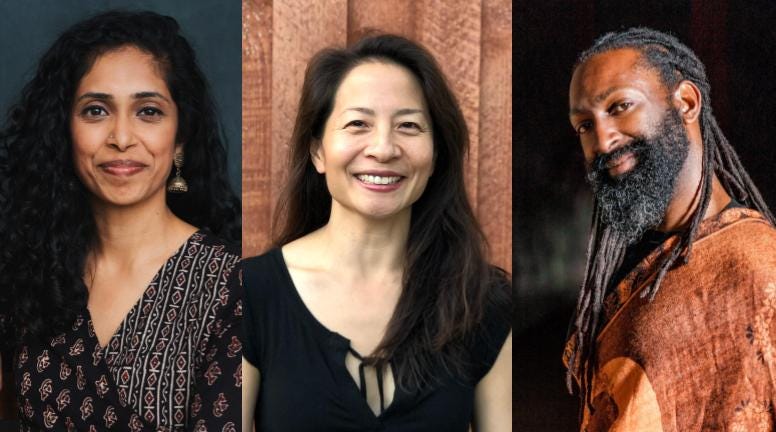
and Antoine Hunter by Mark Kitaoka.
You can listen to this piece on Substack!
choreographer noun
cho·re·og·ra·pher ˌkȯr-ē-ˈä-grə-fər
one engaging in the composing and often the teaching of choreography
– Merriam Webster Dictionary
In order for a choreographer’s work to come to fruition, that dancemaker needs to do more than just the dancemaking. A dictionary might claim that a choreographer is just someone who creates movement, but choreographers do so much more than make people move.
Every choreographer balances artistic work and arts administration work to support their dancemaking. Someone has to manage the budget, write contracts, rent the studio space, draft grants, pay the dancers, update the website, design the program, contact the press, process ticket sales, coordinate production staff, acquire rights to music, and more.
While there are graduate programs and certificate programs in arts administration, the majority of choreographers don’t have a business degree, and very few choreographers have full-time administrative staff. Most dancemakers are project-based artists, working from gig to gig.
Nadhi Thekkek of Nava Dance Theatre, Lenora Lee of Lenora Lee Dance, and Antoine Hunter of Urban Jazz Dance Company are choreographers who have established dance companies in the Bay Area. All of them bring their artistic values to their administrative practices. Antoine explains, “Artists are business people. There doesn’t need to be a separation between the two. But just like business people, you need to allow yourself to make mistakes. In the same way that you take risks in art, you should take risks in business. In dance, you learn how to fall safely – take that learning to your business practices. How much risk do you want to take? How are you going to fall on the floor softly? Create your Plan A, Plan B, and Plan C, so that you know what you will do if you fall.”
Both artmaking and arts administration require risk-taking. What would we discover if we followed a choreographer’s administrative work, like we follow their artistic work? In addition to watching a choreographer’s premiere or attending their work-in-progress showing, we could ask choreographers to share the administrative path that supports their artmaking. Let’s start with these three choreographers who are doing the work – not just making bodies move, but experimenting with how to move administrative practices forward.

“It’s becoming more common for dancemakers to call themselves producers.
In the beginning, I thought, ‘I’m a dancer and a choreographer’ but I have realized
that I have to be a producer to make dances in the Bay Area.”
– Nadhi Thekkek, Founder and Artistic Director of Nava Dance Theatre
Nadhi Thekkek has always been someone who will figure things out. She explains, “When I decided that I wanted to make dances, everything was grass roots – if you’re doing it yourself, you don’t have to pay yourself! But then you start realizing that you are the go-to person for everyone’s questions. What’s your lighting? What’s your production schedule? Who are your dancers? How do we contact them? How do you fundraise for it? You are your own marketing, development, and finance department.”
Nadhi is a bharatanatyam dancer and choreographer who has trained for over 30 years in the US and in India; however, she first found arts administrative mentorship through bioengineering.
Prior to founding Nava Dance Theatre, Nadhi earned a PhD from Rice University. As part of her bioengineering degree, Nadhi spent six years doing cancer research in the Optical Spectroscopy and Imaging Laboratory, led by professor Rebecca Richards-Kortum. This research lab became excellent training grounds for arts administration because of her professor. In addition to teaching Nadhi how to write effective grants and papers, the experience taught Nadhi about “the kind of administrator that I would want to emulate. . . how to bring different projects together, run parallel projects, and manage a schedule over multiple years while also managing egos and personalities.” Most importantly, Nadhi admired “the integrity of my advisor – how she operated on a day-to-day basis, pausing on anything that even seemed remotely unethical. It was great to see someone who was so clear about what they needed to do and who they wanted to be in their circle of work.” Nadhi strives to lead her dance company with the same integrity that she witnessed.
At some point, a choreographer can’t do everything on their own, and Nadhi now engages a part-time marketing associate (up to 5 hours per week), a part-time program manager (10-15 hours per week), and a project-based tour manager. Nadhi explains, “Most of the dancers that I know in the Bay Area will do it all, but there becomes a natural progression to needing to hire someone. I started out doing everything myself, but our company was growing, and there came a time when I was doing more administrative work than dancing or choreography. When you feel that the work is not as good anymore because you’re always fundraising and always doing admin work, then you know you need to hire someone.”
Nadhi is now years out of grad school, and she has found “mentors, guides, and peers who I learn from constantly. My circle is full of generous artists, administrators, teachers who are building relationships and building programs that serve the community at large, locally, regionally, and nationally. And I work every day to pay their generosity forward.” At the same time, Nadhi’s leadership of Nava Dance Theatre continues to reflect her bioengineering mentor: “How I build relationships with collaborators and teams – it almost looks like we are developing a science experiment.” Also, similar to the Richards-Kortum lab, Nadhi looks for people that understand “not just how to do the work, but why we are doing this work.”
As a result of hiring administrative support, Nadhi is happy to report that “my capacity has grown so much. I’m able to do so much more programmatically. Now I’m not only a choreographer and a producer, I’m also the program director for Nava Dance Theatre’s residency program and presenting series, and I’m able to take on advocacy roles to support our local and regional network of artists and cultural workers. I’m in meetings with funders and asking how their programs can be modified to support artists . . . I believe that administrators can learn from choreographers, but that can only happen when choreographers are in those spaces.”

“Knowing how to work administratively is really the backbone of building a sustainable career as an artist – it’s the way that we have to survive here in the United States.”
– Lenora Lee, Founder and Artistic Director of Lenora Lee Dance
Lenora Lee learned about the business of art from other artists. For the first part of her college degree, Lenora was at City College in San Francisco. Lenora remarks, “I was really drawn towards the arts. At that time, I was taking dance classes in modern, choreography and improvisation, and I was also studying saxophone with Francis Wong.” A renowned saxophonist and composer, Francis was a leading force in the Asian American Movement of the 1970s and 80s. After transferring to UCLA, Lenora pursued a dance degree, and Francis continued to have a strong impact on her trajectory. Lenora explains, “Throughout my college years, knowing Francis and witnessing how he navigated the arts was very influential. I could see his strategy in motion really working – he understood the business side of the field. His artwork and practice were embedded in the community, and he worked in partnership with both community organizations and advocate organizations. ”
After completing her dance degree, Lenora started dancing with a couple Bay Area choreographers who were involved with Asian American Dance Performances (AADP), and Lenora was offered an entry level position as their administrative assistant. Choreographer Nancy Ng was the Administrative Director at that time, and Claudine Naganuma was the Artistic Director. They trained Lenora to become the Managing Director. “They taught me to write grants specifically for dance commissions, dance projects, and AADP showcases. I learned about budgeting, writing contracts, contacting artists and venues, managing productions.” Lenora worked at AADP for two years, eventually leaving to dance in New York.
As Lenora returned to San Francisco, she founded her company Lenora Lee Dance. At the same time, Francis hired Lenora as a Program Manager for Asian Improv aRts (formerly Asian Improv Records), the nonprofit that he co-founded in 1987 with pianist and composer Jon Jang. Through her position at Asian Improv aRts and through Francis’s mentorship, Lenora continued to develop the administrative skills to support artwork grounded in community-based activism and social justice. These skills have enabled Lenora Lee Dance to create large-scale, immersive dance performances, such as Within These Walls, a site-specific dance experience and film at Angel Island Immigration Station as part of a community-wide commemoration of the 1882 Chinese Exclusion Act, and A Bridge to Now, a multimedia dance collaboration between U.S. and Peruvian dancers expanding perspectives on immigration in the Americas.
For the last 19 years, Lenora has led Lenora Lee Dance while also working at Asian Improv aRts (AIR), and Francis continues to be a key mentor and collaborator. In 2023, Lenora and the AIR team, along with Francis, officially launched the Asian Improv aRts (AIR) Fellowship program to support community artists in “expanding their artistic practices through one-on-one mentorship, grant writing support, professional development workshops, and production support, all towards bolstering these fellows as they step into becoming leaders of the next generation.”

“For me, the administrative side of dance didn’t come from formal training—
it came from necessity, survival, and vision.”
– Antoine Hunter, Founder and Artistic Director of Urban Jazz Dance Company
Antoine Hunter (aka Purple Fire Crow) was an early adaptor of emerging technology. As a Deaf artist, he utilized these tools to communicate with audiences and artists who weren’t fluent in American Sign Language. Antoine explains, “around 2005, before I even had a formal dance company, I was already building platforms to share my work. I used early tools like MySpace, YouTube, and basic HTML coding to create blogs which were also used to make invitations and newsletters. At that time, newsletters weren’t a common practice, but I found it as a way to connect with people—sharing Deaf culture, dance, and opportunities to attend performances. I also used a BlackBerry (given by the East Bay Center of the Performing Arts) for texting early on to stay connected with dancers, teachers, administrators, and collaborators, even before texting was standard practice. I was self-taught and very tech-driven, which gave me an early foundation in administration. Communication became one of my strongest tools.”
In the early years of Urban Jazz Dance Company, Antoine did everything himself. He says, “access has been one of the biggest ongoing challenges. As a Deaf-led company, not only does Urban Jazz Dance Company face barriers, but we also carry additional responsibility. There is a significant amount of extra work required to coordinate access—securing interpreters, aligning schedules, budgeting for accessibility, and ensuring communication is equitable across all parts of the process. This work is constant and often invisible, but it is essential. There have been times when programs offered multiple resources, but because I needed an interpreter, then I received fewer opportunities. Instead of being supported in five areas, I might only receive support in two. That meant I had to become even more resourceful, teaching myself the remaining skills and finding ways to fill those gaps independently. . . Over time, I learned how to protect myself and the organization better—writing stronger contracts, asking better questions, and thinking more strategically. Asking questions is one of the most important skills in business.”
Antoine now leads Urban Jazz Dance Company in partnership with assistant director Zahna Simon who joined the company as a dancer in 2014. Zahna became rehearsal director in 2015, and she stepped into the Assistant Director role in 2016. Antoine admits that when Zahna first offered to take on administrative responsibilities, “I wouldn’t give her anything! I wouldn’t let anything go. I had taken on everything for so many years because folk always dropped the ball then it’s on me, but Zahna continued to ask.” The process required patience from both of them. Zahna adds, “When I moved back to the Bay Area, I performed in the second year of the Bay Area Deaf Dance Festival, and I was extremely inspired. I let Mx Hunter know, ‘I want to support you. How can I do this? How can I support any further work?’ It was inspiring seeing other Deaf artists in the festival with the same passions as me and I wanted those opportunities offered for other Deaf artists isolated in the world. Mx Hunter gave me just a little bit of work at first, and I kept telling them to give me some more. Give me some more. I can do more. I know that I can. Mx Hunter taught me a lot while trusting my wisdom too.” Antoine and Zahna have now worked together as artists and administrators for over a decade.
Urban Jazz Dance Company reflects the strengths of its two leaders. Zahna focuses more on internal operations and infrastructure, while Antoine focuses more on external relationships, networking, and vision-building. Antoine describes the structure as “a rhythm, taking turns, adjusting and continuing to move forward. . . Administration has become another form of choreography. Administration is not separate from the art—it is how we build space, create opportunity, and sustain the work for the future. “
When we ask choreographers to share their administrative paths and practices, we can more fully appreciate the artists and their artwork. We also find opportunities to learn and challenge our own best practices:
Nadhi learned about administrative skills during her bioengineering graduate program.
- Where have you witnessed or experienced success outside of the arts ecosystem?
- How can that learning apply to your administrative practices?
Asian American Dance Performances and Asian Improv aRts were key points of learning for Lenora’s administrative development.
- What organizations align with your artistic values?
- How can you become involved in those organizations – as a volunteer or as an employee – in order to both support their work and to learn new approaches to arts administration?
Antoine’s partnership with Zahna transformed the Urban Jazz Dance Company.
- Who are the people that already know and care about your artistic work?
- What are the circumstances that you need to cultivate in order to give an administrative responsibility to one of these people?
Perhaps these questions aren’t new to you. But just like in the studio, sometimes we need to practice the same moves in order to find a new way forward.
The questions can also continue beyond our own practices. Nadhi, Lenora, and Antoine are all choreographers. By expanding the definition of choreographer, we recognize that these artists are also business people, producers, community organizers, advocates, and more. How would the dance ecosystem change if this expanded definition of choreographer were more widely acknowledged and discussed? How would the relationships change between choreographers and funders, donors, audience members, presenters, researchers, writers?
Perhaps the creation of new work and the latest premiere would no longer be the primary focus if more individuals and institutions valued all of the different aspects of being a choreographer – the business in art and the artistry in arts administration.
Nava Dance Theatre is a bharatanatyam dance company that uses the south Indian dance form to navigate place, identity, and politics through the lens of our lived experience. Their latest work Rogue Gestures/Foreign Bodies earned Nadhi a 2024 nomination for an Isadora Duncan Award for Best Direction and Choreography. Nadhi serves on the board of the Western Arts Alliance, was on the conference committee for APAP|NYC 2026, and was recently named as a 2025-2026 Dance/USA fellow.
Lenora Lee Dance creates and presents large-scale multimedia, interactive performance works integrating dance, music, video projection, and text that connect various styles of movement and music to culture, history, and human rights issues. Lenora has been an Artist Fellow at the de Young Museum, a Djerassi Resident Artist, a Visiting Scholar at New York University through the Asian/Pacific/American Institute, an Artist in Residence at Dance Mission Theater, and a United States Artists Fellow. Her performance series Convergent Waves was a recipient of NEFA’s National Dance Project Production Grant, with sister productions in Boston, San Francisco, and New York City.
Urban Jazz Dance Company provides opportunities for Deaf and other-abled artists to contribute to the arts and larger society, increasing awareness around Deaf issues via the performing arts. Antoine serves on the board of Disability Rights California and Black Deaf Advocate. His awards include the inaugural Jeanette Lomujo Bremond Award for Humanity and the 2023 Dance Magazine Award. Antoine has been producing the Bay Area International Deaf Dance Festival since 2013 and is launching the World Deaf & Disabled Dance Film Festival in November 2026.