
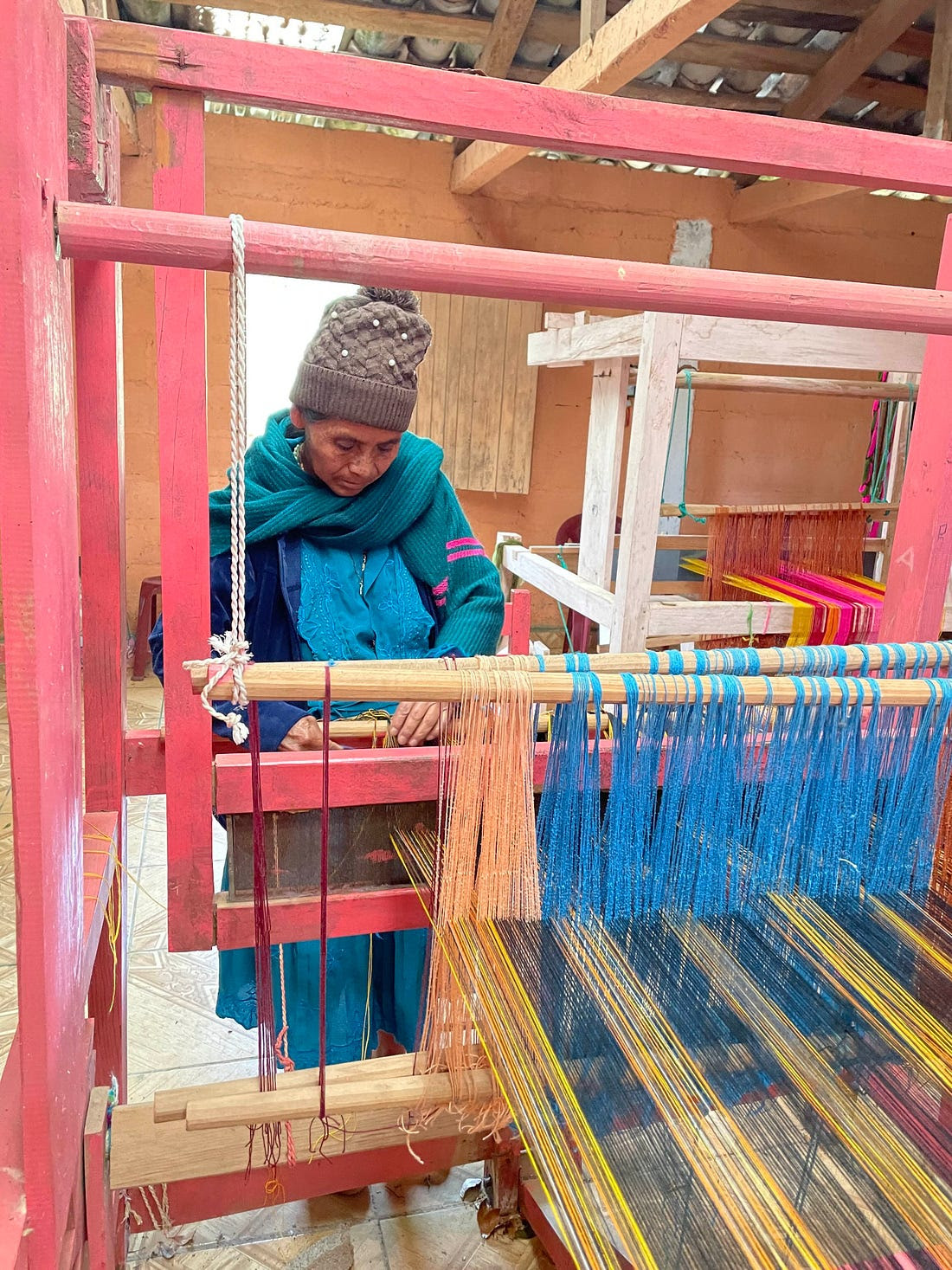
Doña Jesusa has been weaving all her life and has taught the skill to new generations of Indigenous Lenca women in central Honduras. In February 2025, I visited her loom workshop in Honduras with my collaborators, dance artist Isadora Paz Taboada from Honduras and visual artist Gabriel Vallecillo Márquez from Germany, to conduct workshops and research with women from an Indigenous women’s rights group, MURILPAZ.
Yelkaram, which translates to “in the river” in Lenca language, is the second multi-disciplinary project from Isadora, Gabriel and me, artists with Honduran heritage, in collaboration with MURILPAZ, an organization of Indigenous Lenca Women from 8 municipalities in the area of La Paz. MURILPAZ’s mission is to empower Indigenous women to be resilient and adapt to changes while simultaneously preserving their identity and cultural heritage and defending their rights and autonomy. After finishing our first project Savia: Sap flow, presented in 2024 as part of an ARC-Edge residency at CounterPulse, the team felt the need to expand and deepen the exploration of Lenca culture and practices.
Our first meeting was with Indigenous women in Guajiquiro, a community known for weaving fabrics. Jesusa showed us the loom workshop and demonstrated how she coordinates her upper and lower body, pushing pedals with her feet and pushing and pulling with her arms to move the pieces of wood attached to colorful threads. We were very interested in learning the body movements that are executed to weave as a source of inspiration for the choreography. Outside the loom workshop, I guided a somatic movement exchange with eight Lenca weavers and ceramists. I incorporated pushing and pulling movement explorations in duets and in groups. We explored the common elements of the looms and the body, comparing the loom wood with the bones, and the threads with our tendons and muscles. We shared weight with hands, bending and extending the elbows, embodying the movement of the loom, bending-pushing-extending-
The group of participants was smaller than we expected. We learned that some of the young women weavers could not attend because it was coffee harvesting season, and many weavers depend on that income to survive given the scarce opportunities to sell their fabrics. The weavers are struggling to maintain their craft because local people and especially new generations are not buying and wearing their traditional fabrics. There is an invasion of cheap clothing, (“ropa de bulto,” bulk clothing), that comes mainly from the US, and appeals to local people because of low prices and trend-driven styles. It was sad to witness the detrimental effect of consumerism and fast fashion on local textile markets and Indigenous culture.
Many members of MURILPAZ live in El Jilguero 25 miles from Marcala, La Paz, an area of subtropical moist forests and abundant rivers that have been taken care of and protected by Indigenous communities for many centuries.
Being in the Jilguero landscape with its high mountains, mist, and abundant rivers brought back many memories of my childhood. I grew up hiking with my family in La Tigra’s moist forest during weekends and vacations. This place felt so familiar and comfortable and I felt my body relax, longing for this sensory experience.
There was also a familiar fear that I experienced the next day. We met for a second movement and ritual exchange and heard from Donatila Giron, MURILPAZ leader, that an environmental defender and his son had been killed in Comayagua, only 60 miles from Marcala. It reminded me of the impunity and systematic killing of people during the 70s and 80s when I grew up in Honduras under military dictatorship. Fifty years later, coercion and killing of Indigenous environmental leaders by powerful corporate interests is rampant. Honduras is the second most dangerous country in the Americas for environmental leaders. In 2023, 18 defenders were killed, and in 2016 prominent Lenca Indigenous leader, Berta Caceres, was assassinated for opposing the construction of a dam in the Gualcarque River.
The following day, the water of the Santa Ana River washed away our sadness and fear, reminding us that letting go is necessary to continue moving. Twenty women from Opatoro and nearby towns were on the bank of the river collecting branches, bark, leaves, rocks that they felt attracted to. We initiated a movement exploration connecting with the materials that we collected. Each participant explored ways to move with their favorite one using them as an extension of their chest, head, arms, pelvis or legs. Then, we entered the river with our treasures, we moved with them in this new liquid environment as a group, and then together we let them go and saw how the current of the river carried them away. We let them go, and this action, this ritual, deepened our connection to each other and this river.
 |
These experiences and relationships to fabrics and objects from nature was the source of somatic explorations back in San Francisco with Bay Area performers Ronice Stratton and Kriss Rulifson. We spent time in the studio finding ways to communicate with them. Sometimes they moved us and created a character with a specific energy and soul. Other times, it felt that the objects and fabrics carried an essence or a way to be from many centuries ago; we were understanding who we become when we move with them. One day in the middle of an improvisation, I felt intense rage and a desire to protect my objects, and I found myself rapidly collecting and moving them into a corner. I felt the weight of colonization and the contained anger of many generations who were dispossessed.
 |
Working with the Lenca fabrics in the studio was so delightful, the fabrics were alive, the hands who made them were present. Kriss’s body was moved by the fabric, the fabric folding and extending their joints, sometimes creating tension and sometimes releasing and propelling their body in space. Mystery and playfulness were embedded in the exploration. Ronice weaved objects in her body and dragged rocks attached to her chest, she transformed her foot into a powerful rock shoe and protected her chest with the bark of a palm tree. She became a warrior defending rivers and lands.
 |
 |
In June 2025, we presented the result of our explorations in Honduras and in the studio in San Francisco at ODC Theater. The 40-minute performance included visuals created by Gabriel who documented the journey in Honduras, and a dance-theater section performed by Isadora. Their contributions reflected the environmental destruction by extractive companies and the effects of fast fashion on the traditional Lenca indigenous fabrics and culture.
The performances were exhilarating, giving us an opportunity to share the transformative experiences we had, and the depth of Lenca Indigenous culture. But the current climate of fear around immigration was also present, notably in the absence of key collaborators. We could not process USA tourist visas for MURILPAZ members, and Gabriel was deported when he entered through San Francisco International airport even though he had a current tourist visa. Consequently, they were not part of the performance in San Francisco, and we felt their absence.
Fortunately, we were selected to participate in the 10th edition of the International Community Art Festival in Rotterdam, Holland, March 25-29, and the whole team came together to perform Yelkaram one month ago. Participation in the festival was a professional milestone. We watched inspiring artistic projects, many informed by the Theatre of the Oppressed, created by communities all over the world. We met musicians, actors, filmmakers and dancers. Through workshops we shared and learned the methodology and creative processes behind the performances presented in the festival. We noticed that there were few groups working with somatic approaches, and we felt that the festival allowed us to share the impact that somatic practices have on community arts. This is the second time we brought the Indigenous leaders and artists together in Europe. In November 2024 we came together to present a work in progress of Yelkaram and to hold creative workshops to further develop the piece. We had a two-week residency at Spore Initiative Cultural Center in Berlin. Learn more about our process, collaboration with MURILPAZ, and performances at Spore in this short documentary edited by Gabriel.
 |
The Yelkaram artistic team returned to our respective countries nurtured and with the intention to bring Yelkaram to the Indigenous communities that are the source of the project. In this next and final iteration we desire to incorporate a group of youth in the performance, and present the piece in the area of La Paz. MURILPAZ members want to continue weaving art into their activities to foster artistic expression and bolster the revitalization of Indigenous practices and identity.