
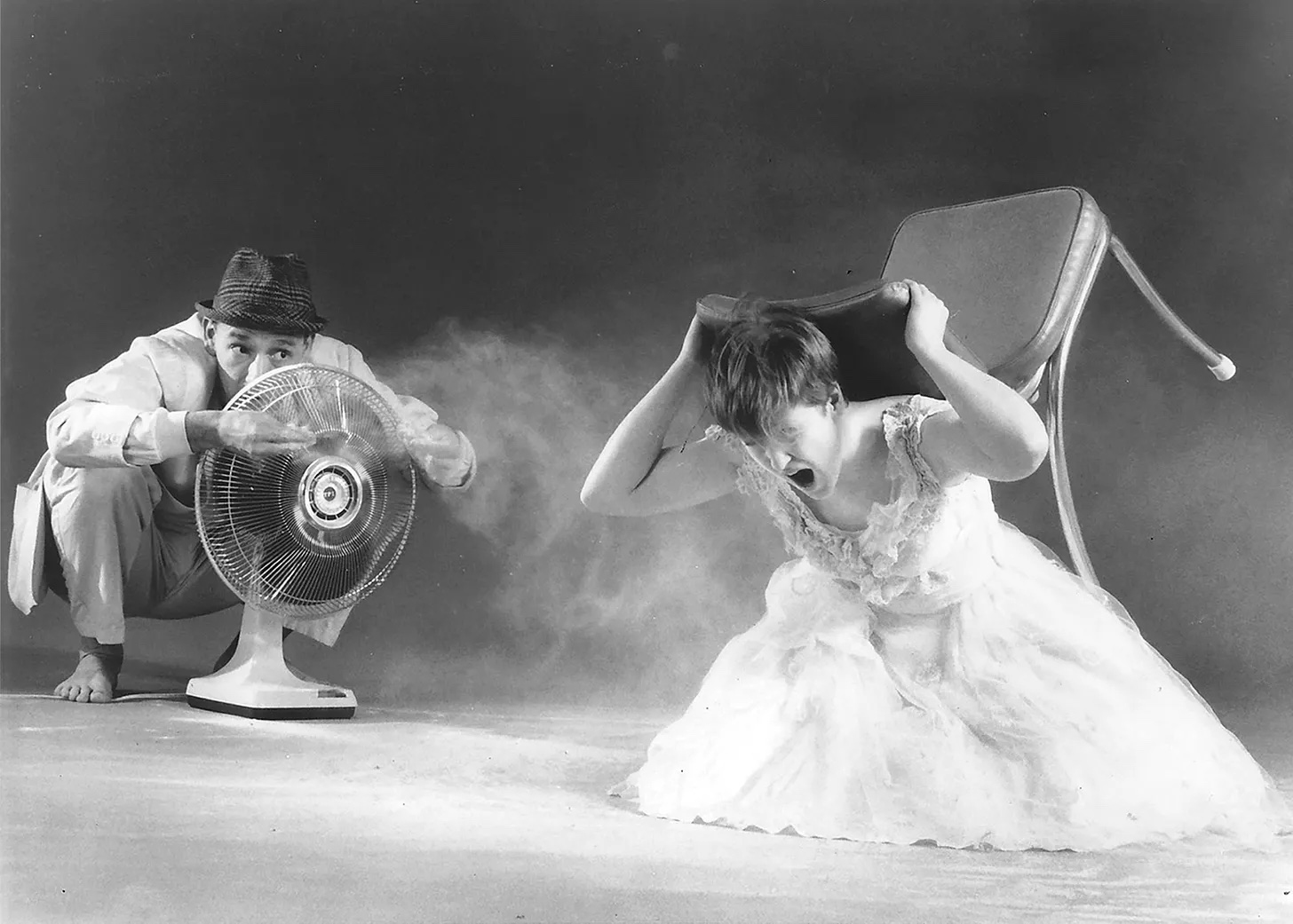
“Why are we crying?” says the stranger standing next to me on the floor of the Joe Goode Annex. It’s a sunny Sunday afternoon in May 2026, and we’ve just finished watching the GUSH Dance Festival, a showcase of nascent dance works produced by Joe Goode Performance Group. This year’s festival is special, in honor of JGPG’s 40th year. The curated roster of choreographers are long-time JGPG artistic collaborators whose relationships with the company span more than three decades. For fans of the company, myself included, the weekend of shows proved to be a momentous one. It featured a reimagined duet for Joe himself with longtime collaborator Liz Burritt (who the old guard know as the dancer perhaps most centrally featured in JGPG’s early works) as well as pieces by fan faves Marit Brook-Kothlow, Melecio Estrella, Damara Vita Ganley, Mo Katzman, Wailana Simcock, Jessica Swanson, and Patricia West.
“I really don’t know,” I reply to the stranger, “it was just really moving somehow.” I wipe my eyes, somewhat embarrassed, and look to the ceiling to stem the tide of tears. ‘Pull it together, lady,’ I instruct myself.
“I have been a fan for such a long time… and it’s just so good to see everyone… and dancing so incredibly…” she spouts. She waves one hand in front of her face, fanning herself. Then she steps up to greet Liz Burritt (turns out she is an old friend), and gives herself over to some affectionate blubbering. I turn away to try to tamp my emotions down a bit.
Why am I crying?
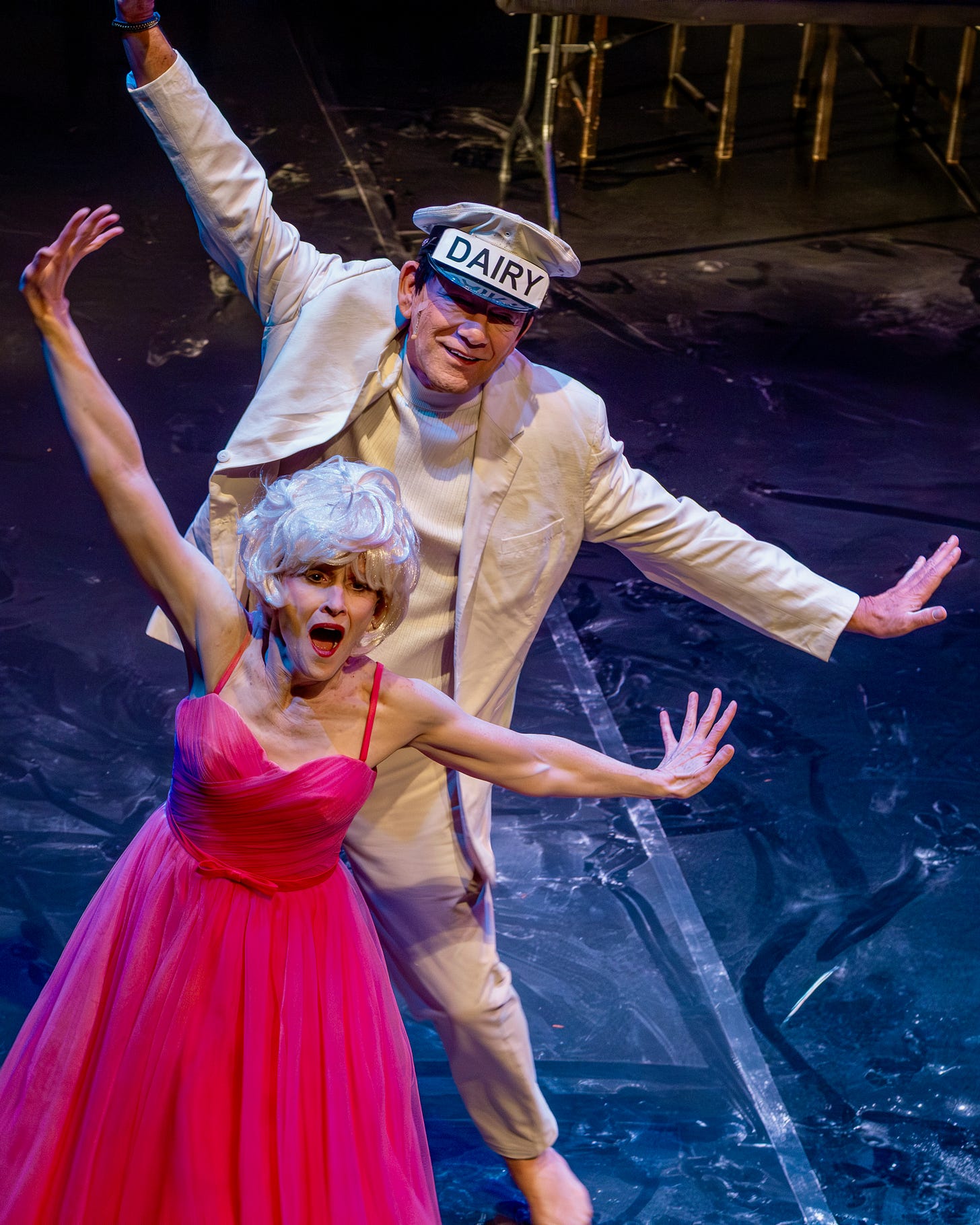
Liz Burritt and Joe Goode perform “Doris in a Dustbowl” (from The Disaster Series, 1989) in the GUSH Dance Festival, May 2026. Photo by Jessica Swanson.
It still feels a little tricky to put into words, which is why, I suppose, it has taken me so long to write this article. I am not close friends with anyone in the company, nor did I dance for or with them (though I sorely wanted to). I have seen their work across the decades, though not devoutly. I have taken classes and workshops, heard talks and even volunteered at their events, but I’ve had similar involvement with several companies over the years.
I do have a deep love for dance theater that is clever and funny and humbling and lived in. I like stories of people and places, of life’s tiny moments writ large. I crave movement that moves me. I love me a lift, a costume, a character, an unexpected cowboy ditty, a creative, site specific romp. JGPG offers all this and more, in 2026 just as it did in 2016, 2006, and, I imagine, in the 80s and 90s as well. So, why this emotional response? Have I just turned into a sap in my “old” age?
I think it boils down thusly:
Something new:
I was introduced to JGPG at an impressionable time in my life (age 20, midway through college) and the company, and in particular many of these company members, became the dancing figures that drew me into professional dance, and by extension into dance writing, scholarship, teaching, and all around dance nerdery. These are the things that light me up, though at times they only get sidelong attention, buried as they are under bills to pay, children to rear, injuries to nurse, aging partners and parents to tend to, regular old work, and life’s laborious and unglamorous logistics. And while I didn’t necessarily realize it until I was driving home from GUSH Festival, tears gushing from my eyes, an afternoon opportunity to bear witness to these folks, and the particulars of the aesthetic that they endeavor as artists, lent me a sense of belonging to a specific Bay Area dance subculture that I still find moving after (and perhaps because of) the twenty-five or so intervening years since I first encountered it.
They represent an enduring, flourishing artistry in a city where we often lament the abysmal lack of support, financial and structural, for performers and performance-making companies. They are a company of caring folks who have managed to weather the storm.
Something enduring:
I find it remarkable that JGPG collaborators are still coming around, and are not backgrounded, but integral to the work. Folks like Marit and Melecio and Jessica and Felipe had key roles in the productions that initially drew me in – i.e., Marit as milk maid in “Harry” (1999), dancing along a line of chairs towards a guitarist in “Grace” (2004), with her plastic bags in “Home” (2005); Melecio repping street youth with Rachel Lincoln in “Home” (2005), or as Wonderboy in “Wonderboy” (2008) – and they are still delivering these beautifully rich performances in JGPG’s full-length works over twenty years later.
It was such a pleasure to see how each piece they created embodied aspects of the company’s aesthetic values, but expressed uniquely with these makers at the helm. Skills honed across years of shared history and genuine shared interest, and nurtured by an ethos of play and discovery, yielded a powerful kind of dancerly prowess and compositional intrigue. For example, Melecio’s offering “Camp St Michael,” danced with his own kid, emphasized character and scene building, complicated dialogue conferred through relationship, and a narrative that sifts through history in conjunction with self-discovery. Marit, Felipe, and Jessica’s work “Grass Island,” involved vibrantly intertwining partner work, the tipping ease of bodies moving in and out of the floor, the unexpected breach of the fourth wall as Marit climbed into the audience in a final, uninhibited moment of seeking. And Jessica and Olivia Sander’s duet “Bunk Beds” featured the two dancers, bedecked in matching wigs and colorful costumes, negotiating space literally and metaphorically as they hung suspended and low to the ground, bodies parallel to the floor with feet on the wall. They turned the world of the dance sidelong, offering fresh perspective for experienced viewers, and the ease of their interplay masked the physical difficulty of what they crafted. Each of these pieces seemed to take an aspect of Joe’s work and process and amplify it out, with new dimensionality, in ways totally devoid of the hollowness of a copycat, and instead unfurling with the potential embedded in the methodology of the work.

Something felt and found:
Through casual interviews with Joe and Marit, as well as Melecio’s response to a question about methods during the GUSH Festival talkback, and my own choreographic observations, I’ve tried to understand some of the building blocks that ‘make the magic happen’.
The JGPG website references the desire to make “human scale dances.” Human scale seems to mean integrating voice and movement, and text, and sound, and story, and somehow encompassing the contradictions inherent in being human. The ideology is described on the website as follows:
The challenge is to find the velocity and force in the movement and yet still retain its intimate, conversational quality… I am equally interested in the texture of the human voice and the effect it has on movement… I want each dance to be a “telling”; telling with the body (where have I been? where does my longing reside?), and telling with the voice (this is how I see the world)… I want to liberate the dancer from his/her silence and create a total theater that is rigorously crafted but intimately personal. – Joe Goode
When I asked about the “how” of creating something rigorously crafted and intimately personal, Joe offered up some fundamentals, a methodology for generating felt material that has been refined across the years. When building a larger piece, he might come in with the general theme and some ideas for how it will be explored. His initial step is “placing interesting questions in front of people and being interested in how they answer, hoping to encourage a kind of deep reflection.” Marit notes that it seems Joe starts with the small, the specific, the intimate, and then works out from there. In practice, this process may involve fulfilling a movement task (Joe gave by way of example “something like travel from the chair to the wall but don’t let your feet touch the floor”). It is often followed with the question “how did that feel?” Then they do it again, noticing what it brings up emotionally, psychically, physically. This exploration might be followed by some writing, then the pulling out of a few key words that get said aloud. Then they do it again. Eventually this found material gets layered with things like repetition, song, etc. and the moments get placed together, patchwork-like, to create an interesting whole.
“I often call them ‘collisions’… this work with felt material,” Joe divulges. The goal is to try “to stay away from simple autobiography – it’s not about listing the traumas, or how your POV is unique, but finding moments that ultimately are gonna feel universal.” This process, he notes, involves a lot of listening, and a commitment to making art that is relevant for the folks in the room. It’s about holding space for the collaborators’ unique contributions and not instructing or talking over people. He notes, “sometimes it means walking performers back from the showing/performing… how instead can you be in it – how do you experience it first, more than deliver it?” Part of the magic seems to come from the tricky space he notes as “trying not to know the outcome – working with material in the moment, not thinking about how to get to the desired place… It’s hard to not map it out for the big finish.”
This process, or at least a similar one, has been employed not only for the “big” pieces that JGPG regularly premieres, but also for JGPG’s weekend intensives and summer intensives (I did one in 2005 – and it inspired me to apply to grad school for my MFA), as well as the company’s community programs including The Resilience Project with veterans, work with LGBTQ+ elders, Movement for Humans classes led by Joe and other company members, and a youth educational program called Inspired Bodies that was started by company members Damara Ganley and Patricia West. The process itself allows the dancers to bring themselves fully into the work, to discover otherwise buried impulses, bits of story, sounds, tunes, meeting places. It is flexible enough that it can be undertaken by aging/changing bodies. It seems to offer up enough, creatively speaking, to make the invitation to the work appealing for those that keep on returning. “I trust Joe so much as a director,” Marit relayed. So do I, I thought…

What’s next…
When I asked Joe about legacy and his visions for the future he said he initially “scoffed at legacy and the nature of it.” His strong conviction was that there was no need to live in the past, and that remounting works from past eras often fails to capture the energy and interest of those currently in the room. He said the overwhelming desire is to “keep making work, keep the Annex alive as a viable, inexpensive rental space, keep our programs, keep all those things that we have very incrementally started, and [that have] achieved some momentum.” He was urged by his board to celebrate this 40th year in some way, and he now concedes that there has been considerable enthusiasm for creative commemoration.

The company is celebrating with a series of “decades dinners,” which are quarterly(ish) gatherings loosely themed around a decade in the company’s history. The first, the Goode Ol’ Hootenanny, happens this Saturday, Sept 19. It’s a casual Western-themed party with apps and drinks and, naturally, Western ballads sung by Joe and Damara. Joe will also be doing a reading from his forthcoming book which is “memoir-ish” (his words), focusing on creative process over the years, but also blended with personal stories – like Chapter One’s love affair with a cowboy that inspired the first decade dinner’s theme. Keep an eye out for future parties, scattered across the year, as well as a big company show in July 2027 at Fort Mason, currently titled “Lessons for the End of the World.”
My plan is to be at the Hootenanny. To raise a glass and swoon at the cowboy tunes. To lean in to my sidelong belonging status with the company, and see what it might encourage as far as my own willingness to play, explore, craft, and create with folks I admire.
And if I have tears in my eyes, maybe just graciously look away. This lady is busy pulling it together.