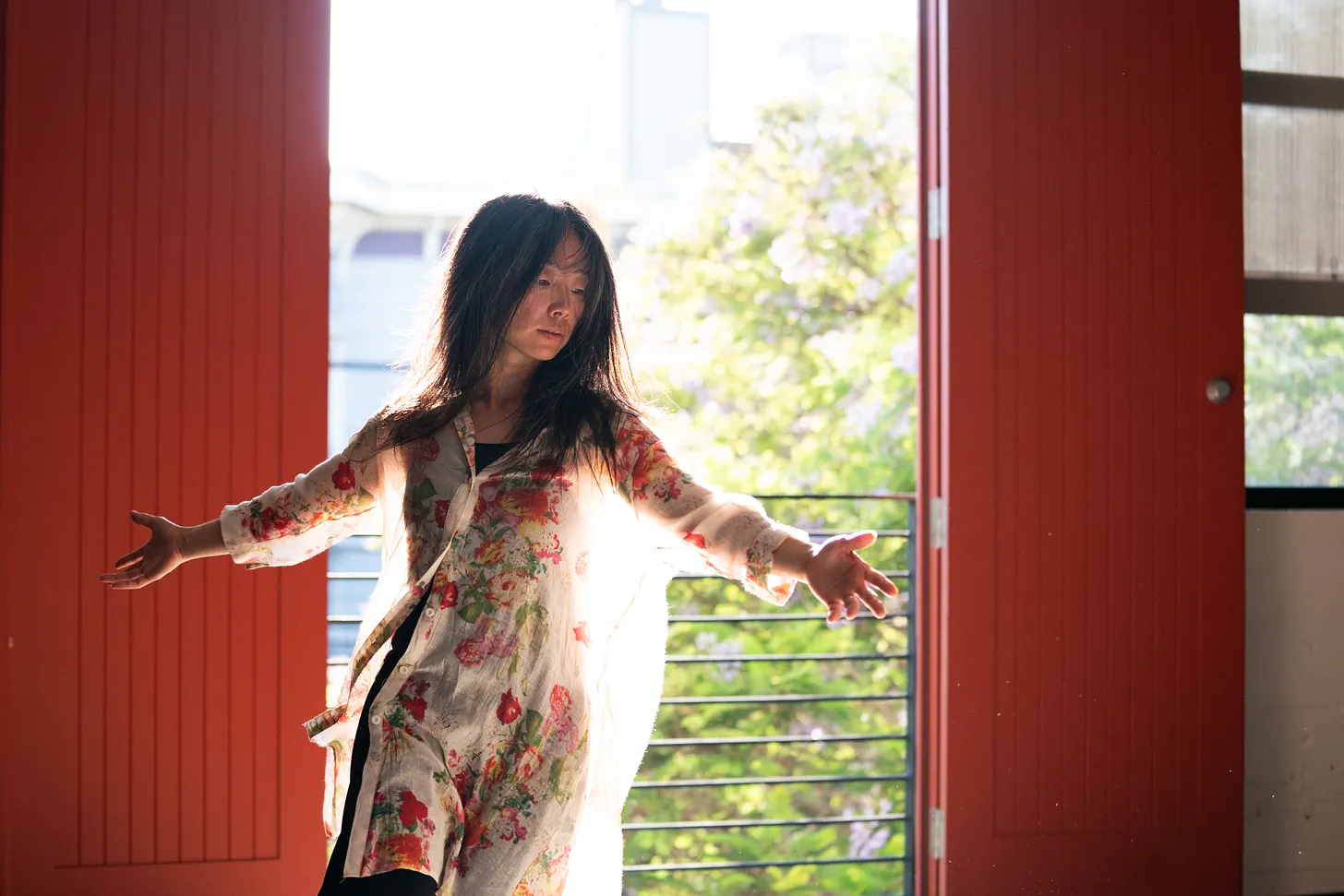
Mihyun at Long Beach Contact Improvisation Festival, 2024. Photo by Eric Allen.
As an immigrant-artist-educator, I’ve learned that a journey is rarely a straight line. There are familiar paths, unexpected turns, places where we stop and reorient, and moments when something new opens up.
I find myself wanting to make a map, not only of my own journey, but of the stories, practices, and pathways bringing together three women who have lived in San Francisco for over 20 years, with different cultural roots, artistic practices, and ways of knowing through the body. We are Diana Lara from Honduras, Body-Mind Centering® practitioner; Mihyun Lee from South Korea, Laban/Bartenieff Movement Analysis practitioner; and me, Joy Cosculluela from the Philippines, Tamalpa Life-Art practitioner. Currently, we are offering Somatic Explorations by Migrant Women classes at ODC Dance Commons, with gratitude to Rachel Recinos Abair, Director of the Nancy Pelosi Healthy Dancers Program, whose generous support has made our classes possible.
In November 2023, we began our journey as a collective, coming together around a shared need to cultivate accessible somatic practices in San Francisco. We brought our proposal to ODC, where Rachel welcomed us to offer workshops in 2024 and 2025. Those workshops have turned into ongoing classes.
I recently sat down with Diana and Mihyun to talk about the places where our journeys touch, diverge, and enrich each other both as migrants and somatic practitioners offering these classes. The response to each question begins with a collective reflection, followed by our individual observations.
How has being an immigrant shaped your relationship with your body?
Immigration is a physical and embodied experience of flexibility, adaptation, and reinvention. Migration can ask us to let go of familiar patterns and develop new ones. We adapt to a new place, culture, language, and way of relating. Somatic practice offers a way to explore this through the body by slowing down, listening to sensation and emotion, noticing habitual patterns, and discovering new possibilities.
Diana: Immigration means letting go of who you were, reinventing yourself, learning new patterns, and releasing others. For me, somatics became a way of repatterning from within.
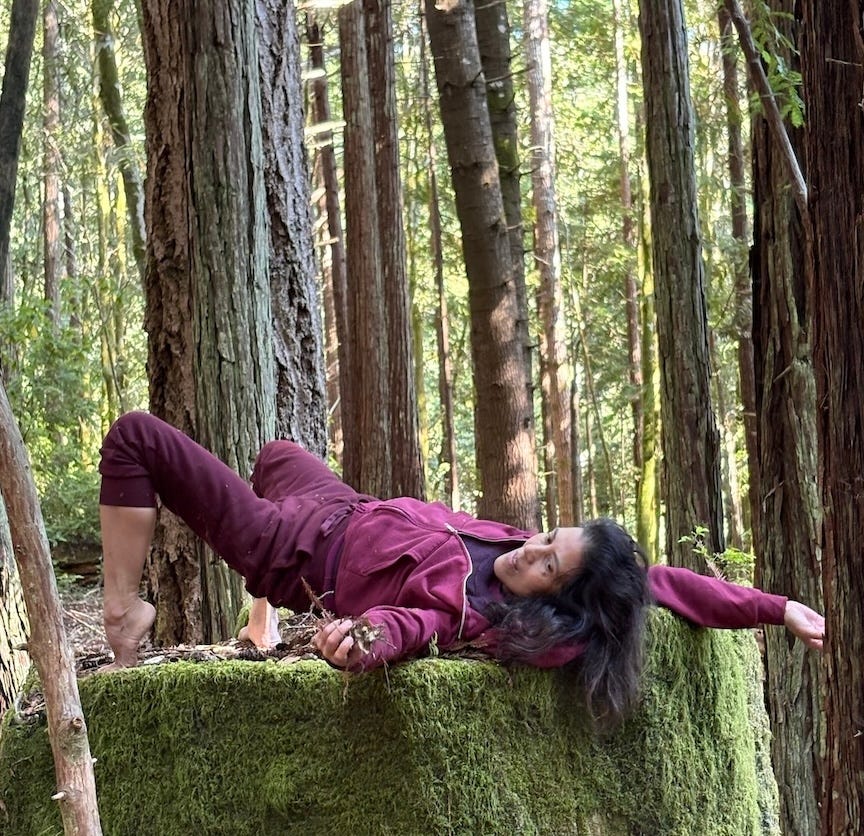
Joy: I recognize that same flexibility and adaptation in my own experience of migration. Somatics asks me to listen to physical sensations, emotions, imagination, and the stories I carry about leaving one place and moving to another. I’m aware of borders, spaces that include or exclude, and the way we move together and far apart. These experiences have informed my sense of rootedness and relationships with others. My practice of embodied creativity and dances in nature have been powerful resources that help me feel grounded, resilient, and alive, especially during challenging times. My body is my compass.
Mihyun: Through somatic education and practice, I have developed a more satisfying relationship with my body because I can listen to bodily reactions spontaneously and respond to my surroundings in a timely manner. My immigrant identity compels me to re-examine the origins and development of who I am by observing cultural preferences, differences, and perceptions in education and society through nonverbal expressions. The more I study and practice materials in the USA, the deeper my understanding of how I became who I am.
Joy exploring belonging with the redwood tree, Sonoma forest, 2025. Photo by Shelley Richanbach.
What is it about your life as an immigrant artist/practitioner that brings you to this work and your specific practice?
A central theme was the desire to bring the lived experience and embodied knowledge of migrant women of color into somatic practice. We spoke about the body as a place where migration, culture, race, adaptation, protection, and belonging are experienced.
We also talked about how somatic practices have often been represented through predominantly white perspectives, while embodied knowledge comes from many cultural, spiritual and Indigenous traditions. We want to make our own knowledge and experiences visible as a contribution and a gift. “Love your color.”
Diana: One of my specific entry points is the skin, a living, porous organ that senses, communicates, protects, and creates boundaries. Migration can change how we open and close ourselves, how we protect ourselves, and how we adapt to new environments, values, and ways of being.
This also means awakening the skin to feel alive and appreciating it, no matter what color it is. I want to acknowledge the complexity of living in a body whose color is seen and can become a place of discomfort because of structural racism, while also asking: How can we love our melanin-rich skin? How can we use our skin to protect and support us? There is something deeply affirming about claiming the body not simply as something seen by others, but as a place of aliveness, protection, and possibility.
Joy: In my somatic and Life-Art practice, I’ve come to know that migration carries its own physical, emotional, and mental patterns: opening and closing, moving toward and moving away, holding on and letting go. It’s part of a larger story of “Where do I belong?” and it’s stored in our bones, muscles, nervous system, organs. We dance, sing, draw and write our stories, the beauty and messiness of life. These patterns are also mirrored in nature. We root, we break, we rise and fall, we decay and regenerate. We are nature. When we see ourselves as nature, we can lean into the part of us that is less hyper-individualistic and more connected. We all belong on this planet.
Mihyun: As an immigrant artist and practitioner, I often feel diminished by the USA’s focus on intellectualization and verbalization. I’ve noticed how words can trigger reactions and restrict our ability to truly experience one another, despite our shared longing for connection. For me, connecting nonverbally feels safer and more authentic. I deeply believe that somatic movement practice allows us to connect with ourselves and with others, transcending race, gender, culture, and language through the resonance of our bodies, from cell to cell, fascia, fluid, muscle, and kinesthetic resonance.
What would you invite someone to do when they enter your class? What becomes possible?
We invite participants to slow down and pay attention to their bodies, their senses, and how they move. We invite each person to listen from within and honor their own experience. From there, movement becomes a way to explore relationships with others and with the world
Diana in movement-partner exploration, The Finnish Hall, 2026. Photo by Ursula Alleyned.
Diana: I invite people to sense the skin against the ground and air, texture, pressure, vibration, tingling, touch, and the relationship between different parts of the body. Closing the eyes can shift attention away from the predominantly visual world toward other senses.
In one class, participants worked with their eyes closed to sense another person’s shape through touch, and then followed another person’s movement and trajectory through space. They were surprised by how much they could perceive without relying on vision. These experiences open the possibility of discovering that the body knows and senses in ways we may not have realized.
Joy: I invite people to sense their bodies in many ways, the rich sensory aliveness when we open our awareness. For example, we explore our connection to earth through metaphors of rootedness, standing, walking, and support. I offer prompts for personal exploration. How does it feel when we move solo? With others? How do we move with support inside and outside?
We ask, What would my earth body say? Through the creative tools of the Life-Art Process, we draw and write and let our imagination speak. Through our relational somatic practice, we witness ourselves and each other. We learn to co-exist, appreciate differences, and sense our interconnectedness.
Mihyun: I am committed to supporting people longing for a satisfying relationship with themselves and others through somatic movement practice.
As an immigrant student, somatic educator, and psychotherapist, I have often felt restricted by cultural and language barriers. Through Laban/Bartenieff Movement Analysis, I found a way to express myself both verbally and nonverbally and to articulate my inner experiences. I invite attendees to ask questions about where, which parts, when, and how the body is moving, using movement as data for exploring the internal world and uncovering what has been repressed or dismissed. Through the practice, a greater sense of self-integration and aliveness becomes possible.
What might participants discover about themselves through this work?
A recurring theme was expansion, the discovery that there are ways of moving, sensing, and expressing ourselves that we may not have known were available to us.
Diana: Participants sometimes say, “I didn’t know I could move this way.” When movement originates from a different place in the body, or when we engage another sense, we can interrupt habitual patterns and discover something new. There is a kind of repatterning that happens through trying something we don’t usually do. I have also seen younger people come to somatics because they feel disconnected from their bodies through spending so much time with technology. They want to breathe, feel the ground, and reconnect with their human body.
Joy: For me, there is a realization that movement can be liberating. We can discover our own dance through curiosity and non-judgment. I want to create a safe-enough space where people feel free to explore. I also feel the power of being in a relational space. Teaching is reciprocal. Students continually learn from each other. We are all learning together.
Mihyun: Somatic movement isn’t fancy or complicated. It is often guided through simple movement practice and exploration with simple prompts. Somatic education increases awareness of the body, self, and others. Through this sensitivity, we can develop kinesthetic awareness of ourselves and others. In turn, it teaches how to live collectively, consciously, or cohesively. Some people won’t see the potential of slowing down and simplicity. Because society demands so much productivity, we tend to dismiss simple pleasures, like how pleasurable my body feels when I drink a cup of water or the breeze between my fingers while walking in public.
What would you like for participants to take with them? And where might this collective work go?
We talked about participants leaving with a felt sense of expanded capacity, with the experience that they can move, sense, imagine, and express themselves in new ways.
Diana: I hope that they see the possibility to discover who they are through sensory and movement experience with themselves and others.
Joy: I hope that they apply it to their lives, from feeling their breath or how they stand or walk. I hope that it extends into their relationship with others and the environment.
Joy’s elemental art altar and students’ drawings, Body is Nature, ODC 2023. Photo by Joy Cosculluela.
What becomes possible?
We also imagined what becomes possible when three immigrant women practitioners bring their distinct practices together into a shared field of inquiry.
Diana: One possibility is to explore the places where our three somatic practices meet, rather than presenting them as separate approaches. The theme of skin offers one possible bridge: opening and closing, protection, boundaries, communication. From there, we could imagine a shared workshop, improvisational exploration, or even a site-specific performance.
Joy: There is something special about working both as individuals and collectively. Each of us brings a different history, practice, and way of sensing. Together, we create a larger field of possibility. Through the body, we can learn to dance with vulnerability and strength. The courage, compassion, and curiosity to explore who we are inside out. I want to build our capacity to feel resourced physically, emotionally, mentally.
Mihyun: I want participants to take sensitivity, consciousness, and easefulness with them.The way we process our emotions and reactions internally is displayed through our affect, movement, breath, and tone of voice. I want participants to practice sensitivity to attune to themselves, listen to their criticism, develop self-compassion, and explore the origin of anger, discomfort, and hatred. Then, they can attend to and process their emotions more consciously. Eventually, they feel at ease facing challenges.
Many artists have been pushed out of the city by gentrification, rising living costs, and the defunding of arts spaces. Our workshops and classes have brought together many people of color and first or second-generation migrants, with a wide range of movement experiences and ages, all curious about somatics. We are responding to a gap in San Francisco’s movement landscape, creating a space where people can encounter somatics for the first time, while also nurturing a community for those who want to deepen their practice.
What began as individual workshops has evolved into an ongoing collective practice. It has been a rich journey for us to have made lives in San Francisco, bringing our histories, our roots, and what we have learned into communities we are part of. We continue to explore what becomes possible when these three voices, histories, and ways of knowing through the body come together in relationship with the world.
Joy Cosculluela, RSME/T is a performing artist, choreographer, and somatic educator. A Tamalpa Life/Art practitioner and Artistic Director of Wayfinding Performance Group and Performance Lab SF, she creates interdisciplinary performance exploring belonging, ancestry, and land. Her practice weaves somatic movement, collaboration, ritual, and nature, inviting embodied creativity and deeper connection to ourselves, each other, and the Earth. wayfindingperformance.com, performancelabsf.weebly.com