
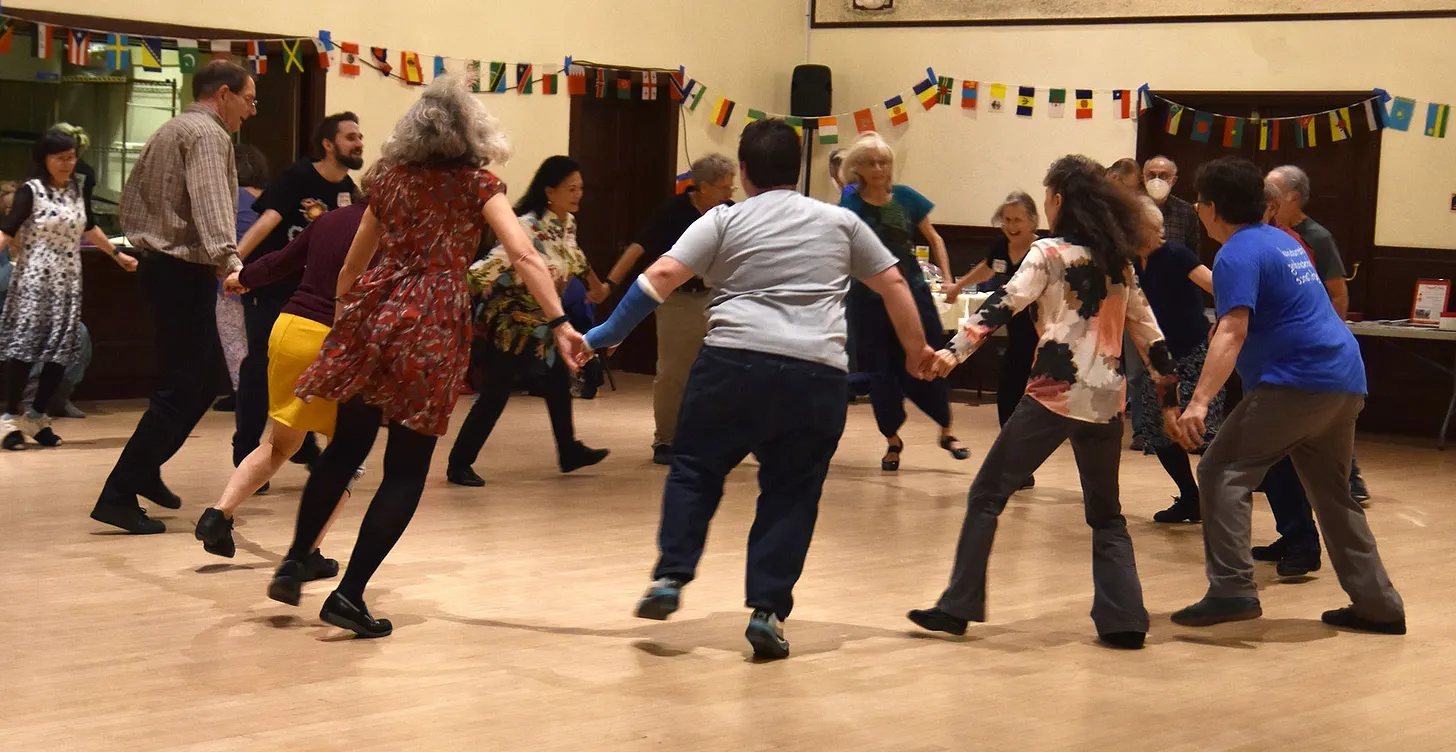
Dancers holding hands, Officers’ Ball, Veterans’ Hall, Pleasanton, CA, circa 2024. Photo by Loui Tucker.
It all began in my elementary school cafeteria, when I was in fifth grade. Winnie, a petite, free-spirited dance teacher with flowing grey hair, taught free after-school international folk dance classes there, and she brought such warmth, drive, and delight to the room that the dancing was irresistible. I was hooked on day one by the earthiness and athleticism of the dancing, the singing and music, the challenge, the focus, and the joy of moving with other people. Those classes set me on a path that has developed into a 50-year career as a dancer, choreographer, and teacher. They also taught me a lesson at the heart of the Officers’ Ball: a single welcoming dance class can spark a passion, build lasting confidence, and shape an entire life.
This year’s Officers’ Ball will take place on Saturday October 3rd, from 1:00 – 10:00 PM, at the Veterans Memorial Hall, 301 Main Street, Pleasanton, California. Get schedule, prices, pre-register, and find a map at the 2026 Officers’ Ball website.
The Ball is both a joyful gathering and a practical fundraiser, raising money for scholarships and grants for people who want to study, teach, or promote international folk dance. Somewhere, the next dancer, teacher, or curious beginner may be waiting for just that kind of open door.
That kind of support matters now more than ever. Cultural dance is very much alive across the globe, yet international folk dance groups are shrinking as members age, and people of all ages grow more isolated and sedentary. Rick Henderson, chair of the Federation’s Institute Committee, notes that young people come, but not in numbers large enough to move the median age very far down. They are dancing, he says, “but not so much in the classes I attend regularly.” This means that younger generations are not benefiting from the unique offerings of international folk dance: the chance to learn dances from many cultures, with respect for the people and places they come from, within one shared community.
I have often heard international folk dancers say that if everybody danced together, there would be no more wars. Proceeds from the Officers’ Ball help keep that experience within reach of the next generation. World peace may be a tall order, but it wouldn’t hurt to start by holding hands.
The Officers’ Ball grows out of a long Folk Dance Federation of California tradition. The Federation was officially formed during a festival at San Francisco’s Golden Gate Park Conservatory in 1942 when several isolated folk dance groups bonded together to share resources, coordinate events, and standardize dance steps. Its magazine, now known as Let’s Dance, began in 1944. Folk dancing in California flourished, and in 1946 the roots of the Folk Dance Federation of California, South, Inc. were formed to manage the folk dance scene in Southern California, while the Folk Dance Federation of Northern California managed folk dance groups in Northern California.
The major fundraiser for the Folk Dance Federation of Northern California was the Treasurer’s Ball, which began in the fall of 1956. In its heyday, the event attracted up to 800 dancers. In its later years, attendance has dropped to fewer than 100. The tradition paused in 2003, when Page Nelson retired from the treasurer role. Loui Tucker, the current editor of Let’s Dance, revived the event in 2010 as the President’s Ball while serving as Federation president. The following year, under Lucy Chang’s presidency, it became the Officers’ Ball, a name that reflects the shared responsibility of the Federation officers in hosting the event. Since then, the Ball has moved among available venues and has been held every year except 2015, when registration was light, and 2020, because of COVID.
Each year the officers choose a theme for the Ball that is related to international folk dancing and dance traditions. Recent themes have included “Life Is a Masquerade,” which was a masked ball; “Joining Hands Across the Years,” which featured some old and new dances; and “Fun-ding the Future,” which raised money for scholarship and grant programs.
The theme for 2026 is “Dance Around the World,” brought to life by six dances ranging from set and couple dances to open-circle and individual dances, spanning cultures from Basque to Punjabi to Bulgarian.
The workshop instructors and dances include:
- Craig Blackstone — Braes of Dornoch (English, set — an elegant three-couple country dance)
- Memo Keswick — Baztan Dantza (Basque, individual — a lively dance from the Baztan Valley with quick, springing footwork)
- Alex Shadle — Bhangra (Punjabi, individual — an exuberant harvest dance full of bounce and big arm movements)
- Lenore Watson — Contras (American, set — social dancing in long lines, guided by a caller)
- Andy Partos — Ländler (Austrian-American, couples — a flowing dance in 3/4 time, a forerunner of the waltz)
- Ina Tacheva — Trakijska Răčenica (Bulgarian, open circle — a spirited dance from Thrace in an uneven 7/8 rhythm)
Today, the Ball continues its fundraising tradition of offering a full day of dancing, learning, food, and friendship. Laura Richardson, president of the Folk Dance Federation of Northern California, describes the format as simple and inviting. Instructors lead an afternoon institute with new and classic dances. A shared dinner prepared by an excellent volunteer chef follows, and then an evening party includes dances from the workshops along with requests from the dancers. Participants come from across the greater San Francisco Bay Area and beyond. The event welcomes both longtime dancers and newcomers. At its heart, the Officers’ Ball helps keep folk dance affordable, social, and alive for the wider dance community.

For many people who have attended, the Officers’ Ball is memorable not only because of the dancing, but because of the connections it creates. Rick Henderson directs the Ball’s Institute. He has attended most of the Balls over the past 15 years and finds them “especially fun because I see and meet other people besides those I dance with every week in the South Bay.” Memo Keswick of the Chico World Dancers feels the same pull, calling it “a networking, staying in touch, sharing across space and time kind of thing.” Leslie Huang is a member of Changs International Folk Dancers in San Francisco, a club that was established by Song Chang in 1937 and still meets weekly. She attended the Ball for the first time last year as a relatively new dancer and found the teaching to be clear, well-paced, and approachable, with review sessions that helped her remember the steps. Together, Rick’s, Memo’s, and Leslie’s experiences show what makes the event work: it is large enough to draw people from many communities, but welcoming enough for someone new to feel included.
The Institute’s workshops are planned to facilitate that sense of welcoming inclusion and feature a lively mix of new and classic folk dances taught by teachers from several Northern California communities. “We try for a mix of teacher location, age and gender of the teachers, ethnicity of the dances, format and energy level of the dances,” Rick explains. That means couple, circle, and set dances, and everything from low-effort dances to “dances that will get us panting.” This year’s six teachers come from as far north as Eureka and as far south as San Jose; three are men, three are women, and not all are of retirement age. In the folk dance world, teachers often learn dances from people who grew up with them or who have studied them closely, and they pass along the history and context with the steps.
Memo Keswick is one of the founders and the current artistic coordinator of the Chico World Dancers, a community group in Chico, California, that has been teaching and performing global folk dances since the 1970s. A past president of the Federation, Memo met his wife, Judy, dancing in Chico in the late 1970s, and together they have organized the group’s weekly dances and monthly parties for decades. Memo also leads a band and singers who play live versions of the dances they love. His path to teaching Baztan Dantza at the Ball illustrates how personal folk dance traditions can be. He first learned this Basque dance in the late 1970s while studying Spanish in Mexico City, at an international folk dance gathering hosted by Mexican dance teacher Alura Flores de Angeles. His teachers were California’s Dean and Nancy Linscott, and Dean was then one of the few teachers of Basque dance. “I loved learning the dance and have enjoyed doing it ever since,” Memo says. When the Federation invited him to teach, it chose Baztan Dantza from his options, he believes, because it adds variety to the mix and because “many will remember it, but it’s not often done in clubs these days.”
Craig Blackstone, past president of Changs International Folk Dancers and current parliamentarian of the Folk Dance Federation, brings a similar thread of continuity. He has taught at the Ball several times, and because he particularly enjoys English and Scottish set dances, he offered the committee four or five to choose from. They selected Braes of Dornoch, a three-couple English set dance he learned from beloved English Country Dance teacher Bruce Hamilton at the 2011 Stockton Folk Dance Camp. Craig suspects it was chosen because “it has not recently been taught in the area at any Federation event.” These examples show that the Ball is more than a one-day event; it is one thread in an ongoing tapestry of sharing culture, dance, stories, teachers, and friendships.

So how do new, younger dancers find their way into the international folk dance circle? “Getting younger dancers to carry the torch forward is something we talk about a lot,” Rick says. “It can be discouraging.” Memo and Craig have both seen the answer up close, and it’s a mixed one. Memo recalls a group of young friends in Chico who once had their own night of dancing and showed up at the dance parties, until careers, families, and moves carried them off. “We’re always eager to have youngsters join us, but making a connection with them that sticks is quite a challenge,” he says. The newcomers who stay tend to come through community classes, including local recreation districts and the Osher Lifelong Learning Institute (OLLI), and one younger dancer recently suggested short Instagram videos to reach her generation. Craig Blackstone has found that young people “enthusiastically participate in classes where they learn dancing together with their peers,” but such opportunities are very hard to find. With dance, music, and arts classes cut from many public schools and colleges, he expects them to become “of increasing rarity.”
The loss of these educational settings makes community dance clubs and organizations essential. They keep folk dance within reach through classes; Family Nights; Dances for All Ages lessons; free or reduced fees for young people; performances; scholarships and grants for camp attendance, teacher training, and events; and the steady encouragement of the wider folk dance community. As someone who teaches, I see how much it matters that newcomers feel welcome, not just allowed, and that their first dance experiences are engaging and encouraging. The Officers’ Ball serves to keep that door open by funding these activities.
It is not uncommon for younger folk dancers to belong to families of dancers who brought their children with them to dance classes and events.
My daughters, now college-aged, have grown up attending folk dance classes, festivals, performances, and camps. At first they came to classes on my hip, while my husband Alex Hosmer performed double duty as teaching assistant and caregiver as the need arose. Later they blossomed into teaching assistants themselves! Federation scholarships helped make it possible for them to attend Stockton Folk Dance Camps and form lasting bonds with members of the international folk dance community.
While both appreciate the folk dance scene, my older daughter, Sophia Hosmer-Hughes, has continued to dance at Changs and attends dance camps when her work schedule allows. She recently told me, “What has become meaningful to me as a folk dancer over the years is the inspiration to become a better dancer; the chance to learn about other cultures through dance and music; the beauty of an intergenerational community; friendships with teachers and dancers from around the world; the joy of moving together; and the deep feelings that grow from holding hands and dancing together over the years.”
Nearly 60 years after Winnie opened that door for me, my daughter described, in her own words, everything I found there. Somewhere, someone is waiting for a Winnie. Come dance, bring a friend, and help hold that door open, just as Winnie once held it open for me.