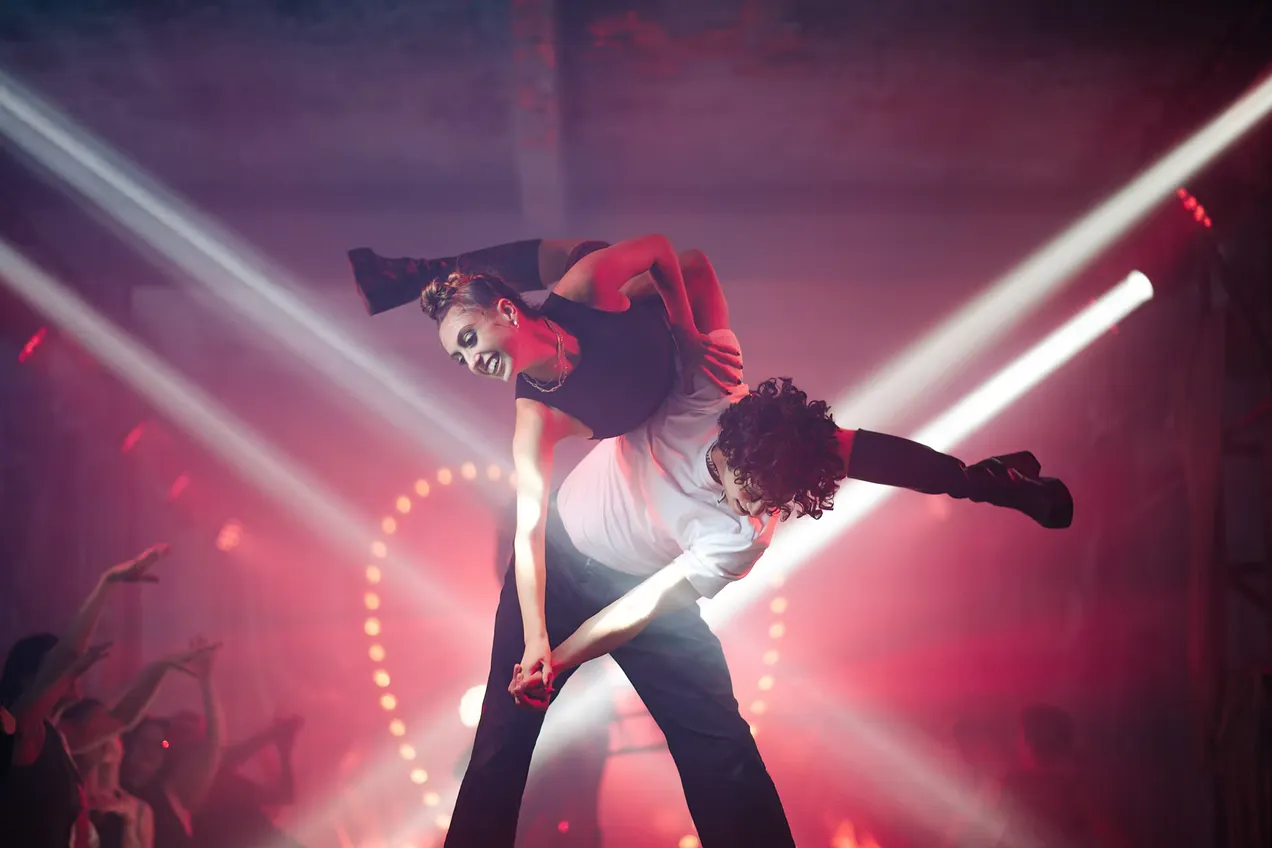
SFDFF 2026: “These Violent Delights.” Directed by Oscar Sansom and Christopher Hampson. Choreographed by Julia Cheng, Morgann Runacre-Temple, Myles Thatcher, Sophie Laplane, Nicholas Shoesmith and Andrea Azzari. (United Kingdom, 2026).
When Greta Schoenberg founded Dance Film SF in 2010, the non-profit that presents the San Francisco Dance Film Festival, the intent was to bring San Francisco into the circle of established dance film festivals in Los Angeles, New York, and London.
What started as an intimate, mostly local film shorts-driven program held over a single weekend has grown into an elaborate multi-day event with international appeal. During the 17th Annual San Francisco Dance Festival, more than 80 films from around the world will be presented at five venues across San Francisco, October 23 – November 8. Viewers from afar can catch the 2026 festival through paid streaming access during the Online Festival, November 9 – November 30.
The Evolution of SFDFF
“Although the festival was my ‘baby,’ I soon met so many talented, reliable, experienced collaborators that I was able to confidently pass on my torch as I turned my focus to having two (actual human) babies,” Schoenberg says. Today, she is the Associate Director of Programming and leads the short film selection process.
Through tireless team effort and several key partnerships—including with Dancers’ Group, as well as San Francisco Ballet, Alonzo King LINES Ballet, and various local and international independent dance artists—SFDFF has become the largest dance film festival in the world.

Dancers’ Group Helped SFDFF Take Root
Dancers’ Group co-presented SFDFF’s inaugural event at the Ninth Street Independent Film Center in 2010 and in recent years, has co-presented SFDFF’s Bay Area Shorts program.
In Schoenberg’s words, “Dancers’ Group has been a consistent partner for our festival from its inception, stepping up as our first sponsor and supporting us every year since. We are forever grateful for this early encouragement and for their continued help in getting the word out to the dance community about our events and artist opportunities.”
Marketing Director, Katherine Disenhof adds, “We are extremely thankful to have continued our partnership with Dancers’ Group through the years. They’ve anchored themselves as a pillar of the local community and are uniquely positioned to support our work.”
Surging Interest in Dance Film
Technology advancement has largely driven the surge in film interest globally. Social media and camera phones changed everything, prompting growing acceptance of these tools in film. Schoenberg says, “In our dance filmmaking workshops, we encourage iPhones to keep things accessible and easy. When I first started the festival in 2010, YouTube and social media sites were still new and not yet fully utilized by choreographers as platforms for distribution. The quality of uploaded video was questionable, and most artists and festivals, including ours, insisted on submission of hard copies of films for proper review. This meant that as a new organization in our first couple years, filmmakers literally mailed DVDs to my house, and I invited respected members of the community over to sit and watch them together (including KT Nelson of ODC, and many other early supporters). Although that was a cozy start to my seedling concept, it was not sustainable as our submission numbers quickly grew. Needless to say – the ability to transmit a film effortlessly and inexpensively across the globe broke down a huge logistical barrier from both sides.”
* * *
In conjunction with expanded interest in filmmaking, a soaring demand for web portals facilitating creative content transmission and storage emerged. Today, millions of filmmakers – of all genres – rely on digital content platforms to submit their work to film festivals and contests worldwide.
“FilmFreeway has significantly lightened our administrative load as we now manage as many as 500 annual entries and must sort, rate, and categorize all their data,” Schoenberg shared. “We are thrilled to now receive entries from 50+ countries and all seven continents. Yes, we even screened a dance film shot in Antarctica.”

Unforeseen global events have also shaped interest in dance film. Schoenberg says, “The pandemic inspired nearly every working dance artist in the world to get their work out into the world through this medium.”
Disenhof adds, “During the Covid-19 pandemic, we saw a significant increase in the number of film submissions as artists worldwide shifted their focus from stages to screens. The number of annual submissions we see are still above pre-pandemic levels.”
Broadening Exposure and Scope
In 2025, DFSF appointed Los Angeles based TV and film producer, arts leader, and former soloist with San Francisco Ballet Garen Scribner as the Artistic Director. Being in proximity with the entertainment industry has proven advantageous, enabling Scribner to scout, network, and increase SFDFF’s visibility.
Sharing some insight on behalf of the new Artistic Director, Disenhof says:
“Garen’s vision centers on broadening what people think of as dance film and making the festival a place where filmmakers get seen and supported;
He is interested in redefining the genre beyond documentaries and concert footage, which is why our recent programming has included more mainstream movies like Dirty Dancing and Center Stage, alongside new work;
His view is that a great dance film is simply a compelling film, one with emotional depth and impact, and that dance is a universal, human form of communication that people understand more readily than they think.”
Seeding the Future
Scribner sees helping artists reach the finish line as the next big area of growth, so that SFDFF is both a platform for amplifying filmmakers’ work and a producer of new work. In the early years of the organization, DFSF observed a growing need for support in dance film development among local choreographers and filmmakers. The experimental program Co-Laboratory Project (Co-Lab) helped answer this need, supporting 20+ dance film collaborations from 2013–2024.
What was formerly known as the Co-Lab Project is now the SIGHTLINE initiative.
“As we look toward our 20th anniversary, our focus is expanding from presenting great work to actively creating it,” Scribner says. By commissioning original dance films alongside world-class artists and leveraging our expanding global digital footprint, we are ensuring urgent, boundary-pushing projects find both the funding to exist and the worldwide audience they deserve.”
Diversifying Dance Forms
Each season, SFDFF presents culturally and artistically diverse films from around the world.
And, Schoenberg attests, “We are always looking for new and underrepresented dance forms to diversify our offerings as much as possible. The majority of the work we receive falls into the very broad category of ‘contemporary dance,’ however we do have strong ballet films, and many films featuring urban and traditional non-Western styles.”
Featured dance forms during the 2026 season will include aerial dance, ballet, ballroom, commercial, contemporary, experimental, folk, hip hop, jazz, Latin, modern, pop, social, street, and traditional, among others.

Categories & Themes
Nothing conveys the evolution and range of dance films more than the distinctly named Dance Film Categories. Each film in the festival is categorized into one of the following: art/experimental film, documentary film (feature or short), live performance film, music video, narrative dance film, and screendance film.
SFDFF’s programming is shaped around the impactful themes filmmakers choose for their choreographic storytelling. In the 2026 season, themes include: creative process, escapism, love, hope, power, illness, tragedy, dysfunction, disability, identity, social justice, technology, and climate—an ongoing topic of concern. Over the years, SFDFF has featured dance films on climate nearly every season. Recent examples include: A Return to Movement (2024), Not Now (2024), A State of Thirst (2023), Crack (2023), Branche (2023), Fram (2019), and Dancing on Icebergs (2018).

The 2026 SF Dance Film Festival
Among the most anticipated events will be opening night on October 23 at the Lucasfilm Theatre. The live performance capture of the ballet Nureyev, staged this year by Staatsballett Berlin, marks the first time the piece has been performed outside of Russia and is the first time the film is being presented to American audiences.
The three-act ballet, choreographed by Yuri Possokhov—SF Ballet choreographer in residence, formerly with Bolshoi Ballet—first premiered in 2017 at the Bolshoi Theatre but was banned in 2022 under Russia’s gay propaganda law, an anti-LGBTQ+ law banning the distribution of propaganda of non-traditional sexual relationships.
The screening offers San Francisco audiences a rare opportunity to see a controversial stage work that’s unlikely to tour within the U.S. and was made possible through a special arrangement.

More Happenings: Mission District | Potrero Hill | The Embarcadero
The Delancey Street Theater on the Embarcadero will be the center of multiple screenings including The People’s Palace on October 28. The film honors a more culturally inclusive story of San Francisco and features Zaccho Dance Theatre dancing vertically beneath the rotunda dome inside San Francisco’s City Hall.
Catharine Clark Gallery in Potrero Hill will host Dance Heals on November 4, a program exploring human capacity and resilience with eight short films, a performance by dazaun.dance, and an art exhibit by Sandow Birk.
DJ music will be cued at SHACK15 social club inside the Ferry Building on November 5 for the short film screening/mixer dubbed Cue the Music. The program includes one of this year’s climate themed works, Have You Considered? a music video about climate anxiety and what we take for granted featuring Bay Area-based aerial dance company BANDALOOP.
The Brava Theater in the Mission District serves as the anchor venue with multiple screenings including a free Filmmaking Masterclass Series on November 7 and closing night festivities on November 8 featuring Bay Area Shorts, live dance, and a closing reception.
After the festival wraps, excitement builds for the 2026 SFDFF Awards. Winners are chosen by an independent award jury in the categories of: Best Feature Capture or Adaptation; Best Documentary Feature and Best Documentary Short; Best Short Under 5 Minutes and Best Short Over 5 Minutes; Honorable Mention; and Audience Favorite. Filmmakers planning for 2027, look for submission details and dates in January for the next SFDFF.
* * *
Since the emergence of motion pictures, the dance film genre has expanded immensely. Mainstream feature and documentary dance films serve a critical purpose introducing dance to new audiences. As storytelling within the digital space rapidly evolves, dance films are taking new shape. During the 2026 SFDFF this perpetual metamorphosis will be on glowing display.