
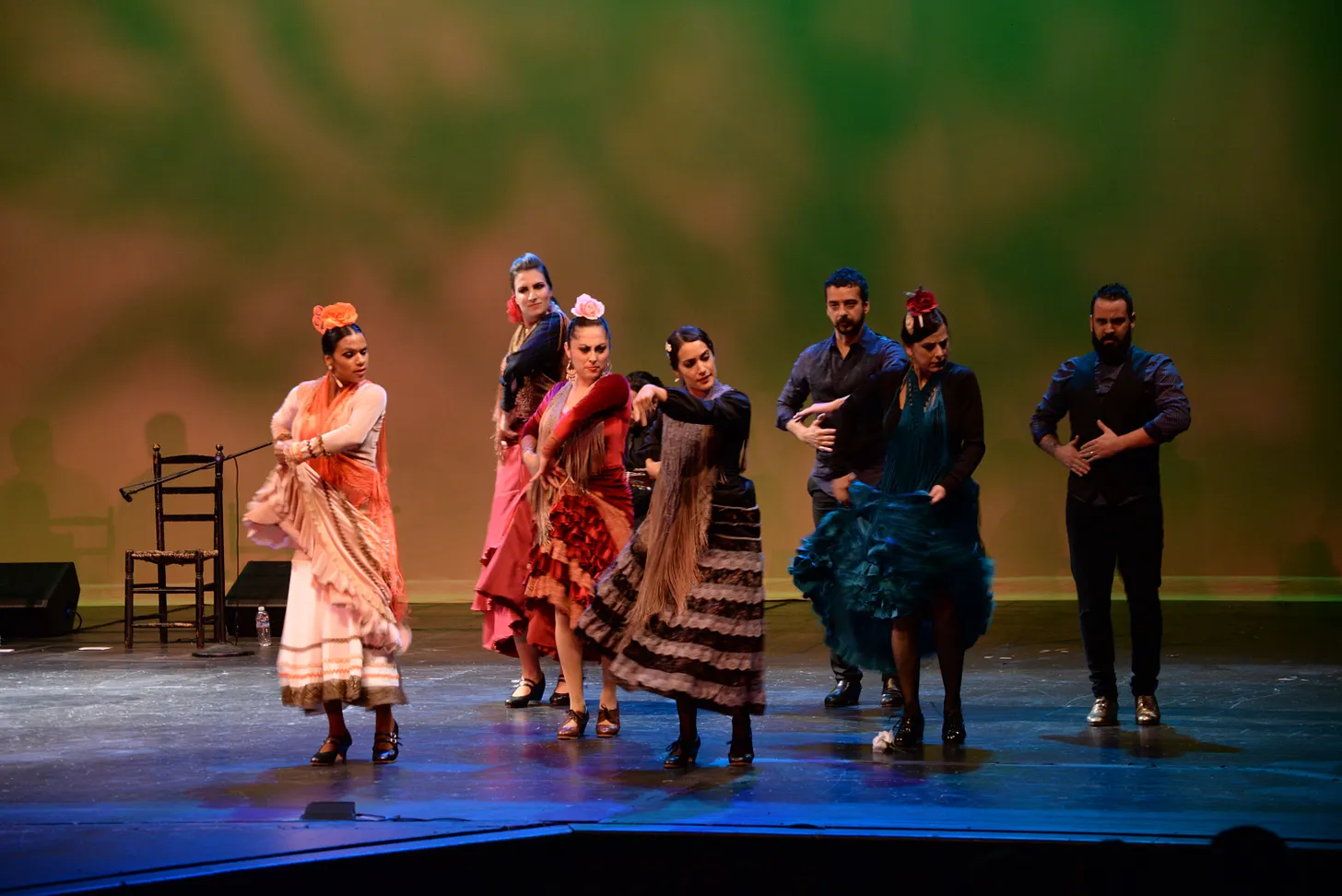
Theatre Flamenco perform “Flamenco (R)evolution” (2015). Photo by Art Cervantes.
Over the remarkable span of 6o years, Theatre Flamenco of San Francisco has flourished as the country’s longest running flamenco company. Enduring with grace, the company’s founding is deeply intertwined with flamenco’s local roots while its future brims with possibility.
Flamenco Found a Home in the Bay Area
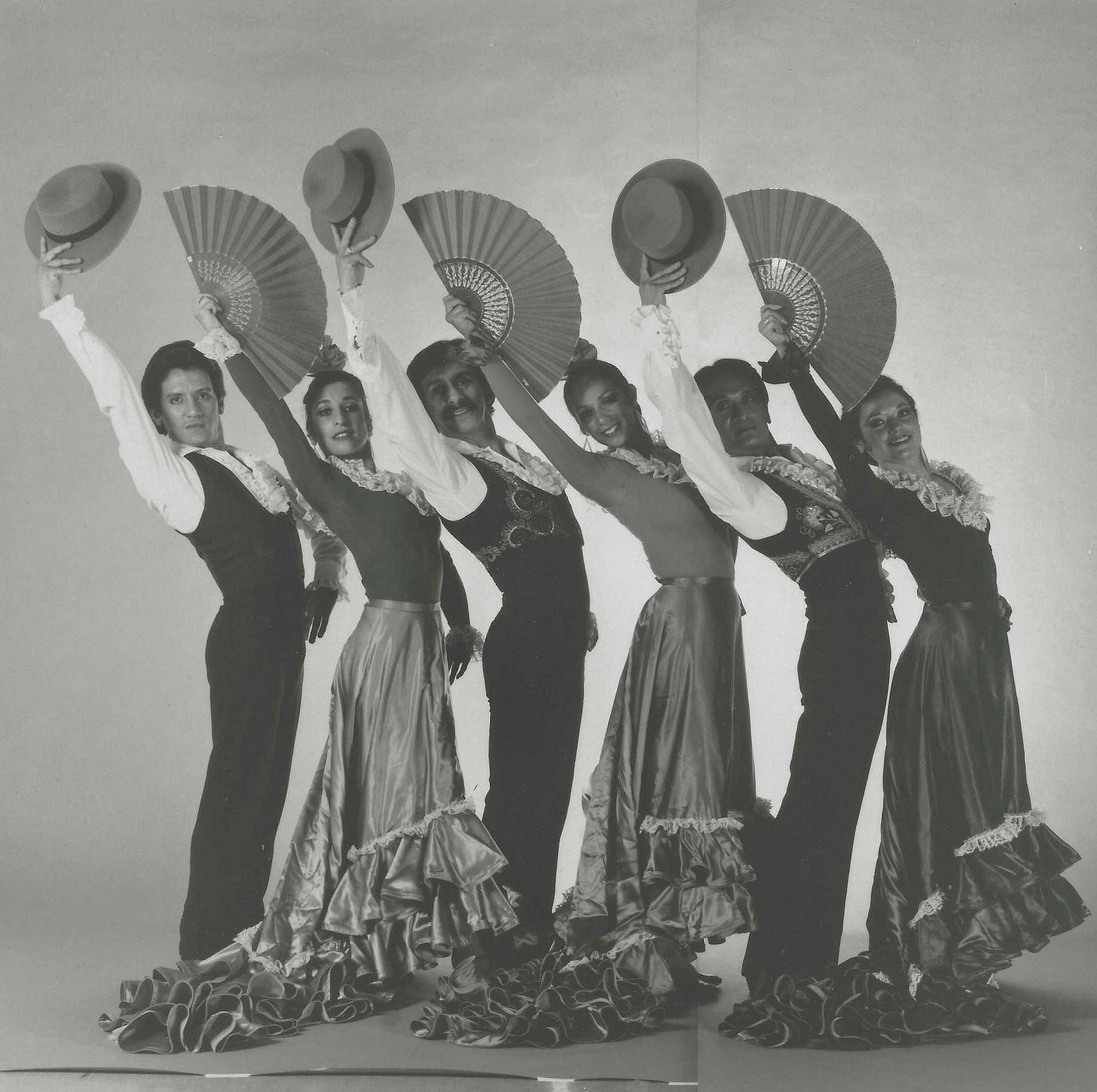
The allure of 1950s San Francisco was irresistible, attracting flamenco dancers, singers, and guitarists far and near, as if a soft flamenco guitar called to them in the distance. The song and dance of Andalusia found a home in the Bay Area and the pulse of flamenco lives on.
Flamenco artists of distinction who frequented the Old Spaghetti Factory were Theatre Flamenco’s Adela Clara and Miguel Santos, Cruz Luna, and members of Los Flamencos de la Bodega, featuring Ernesto Hernandez, Sara de Luis, David Serva and Freddie Mejia, and Isa Mura.
The 1960s marked the beginning of San Francisco’s first traditional flamenco tablaos, starting with Cruz Luna’s Casa Madrid on Broadway, followed by La Bodega on Grant Ave, where the flamenco community thrived for decades.
A Flamenco Institution
Over six decades, three Artistic Directors devoted their lives to building a flamenco institution. Founded by Adela Clara in 1966, she led Theatre Flamenco for the first two decades before naming Miguel Santos her successor. In 2006, the role was entrusted to Carola Zertuche, who’s led the company for the last twenty years.
This year’s 60th Anniversary celebration, De Ayer a Hoy/From Yesterday to Today, is bittersweet, having lost Theatre Flamenco’s founder Adela Clara in May of 2026 and former Artistic Director Miguel Santos in 2024. In their absence, flamencos in the region are reminded of the everlasting imprint these giants left on the community they helped build.
While founder Adela Clara was originally from Kingston, New York, she was raised in Oakland. After pursuing her professional dance career in New York City, she returned in the 60s with her vision: to present full-scale, theatrical, Spanish dance productions featuring classical guitar, dance, and poetry to Bay Area audiences.
Miguel Santos joined Theatre Flamenco in 1968 as a principal dancer and choreographer and was appointed Artistic Director in 1987. Grand-scale theatrical productions and education programs were his mainstays.
Zertuche’s collaborations with Theatre Flamenco as a guest dancer and choreographer began in the early 2000s. As Zertuche transitioned to Artistic Director, the original vision was preserved while moderate shifts in the company direction were made. Among the changes Zertuche envisioned was increasing the number of collaborations with musicians and singers from Spain well-versed in traditional flamenco.

An Extraordinary Legacy
Looking back, Zertuche says, “What I remember most fondly is the trust Miguel placed in me from the moment he invited me to become Artistic Director. He gave me complete artistic freedom to develop my ideas, invite artists, and shape the productions, and that was a wonderful gift. One piece of advice he gave me, which I still try to follow, was to avoid conflicts with people and always leave doors open—I hope I have lived up to that. I loved Miguel dearly and have tremendous respect for him. He entrusted me with an extraordinary legacy, and I will always be grateful to him.”
Describing what attracted her to becoming Artistic Director, she explains, “Onstage, I love to experiment—with music, dance, staging, costumes, and lighting. One of the reasons I was so happy to take on the artistic direction of Theatre Flamenco was the opportunity to create productions around a concept and develop it through all these elements.”
While reviewing archival performance footage in preparation for this year’s milestone anniversary, Zertuche had some time to reflect. She shares, “I felt proud to see that each year I created a different production, with its own concept shaped by what I was experiencing at the time.”
She adds, “Although I began with classical Spanish dance, I later devoted myself more fully to flamenco, and that became the focus of the company under my direction. I have great respect for these different traditions, and I believe in presenting the forms I feel equipped to explore with depth and integrity.”
Classical Spanish dance and flamenco are interwoven, with the former blending its traditional Spanish folk roots with classical ballet; and flamenco, shaped by its origin in southern Spain, incorporating cante (singing), toque (guitar), and dance (baile).
As a company, its education programs garner staunch intrigue. Whether a youth’s first exposure to Theatre Flamenco is during a full-scale stage production with their parents, or during an educational outreach performance for a city school event, the impact can be profound. Zertuche says, “Young people come to a show, ask questions, and join classes. From what I see, interest grows through that opportunity to experience flamenco onstage.”
Teaching the Essence of Flamenco
Theatre Flamenco offers classes year-round at their studio space on South Van Ness in the Mission District – for dancers of all levels – adults, teens, and children ages 4-11. From introductory classes teaching basic footwork, arm movements, and rhythms; technique and choreography instruction; to special workshops – the options are many.
Describing her approach to teaching, Zertuche says, “My teaching is rooted in traditional flamenco, which is the foundation of my own training and experience. From the very beginning, I emphasize cante—the singing—because, for me, it is the foundation of flamenco. Alongside technique, I want students to understand the deep connection between the singing and the dance. As they progress, we explore the different palos, or flamenco forms, each with its own rhythm, character, and expression. Depending on the students’ level, I may also introduce more modern movements or experimental ideas, always grounded in that tradition.”
As flamenco constantly evolves, new ideas help sustain its endurance. A fine blend of tradition with contemporary concepts, and music fusions speaks volumes among modern audiences.
Each season, Theatre Flamenco brings innovation to its repertoire, as it did with last year’s sold-out world premiere of Tríptico featuring Nol Simonse who integrated modern dance. Bringing relevant narratives to the stage also resonates with audiences. An example was Zertuche’s 2024 production, Pasajes Flamencos, which took on the subject of child suffering set to Arabic melody.
Choreographic inspiration has no limits. Zertuche says, “My inspiration comes from everyday life: something I am going through personally, what is happening in the world, a painting, or a conversation. From there, a production begins to take shape. Tradition is my foundation, and from that, I find the freedom to explore and create.”
Frugal Times Call for Resourcefulness
Theatre Flamenco’s longevity is momentous, yet it still faces operational challenges that are common in the arts and region. Dancers’ salaries, limited resources for administration, and rent increases weigh on the company – making it harder to find a permanent home to secure its future.
“Having full-time dancers has always been a goal of mine, and it still is,” says Zertuche. “It feels even more difficult now, given the challenges facing the arts, especially in San Francisco, and, I believe, around the world. It remains something I would love to achieve, but the current economic climate makes it a very challenging goal.”
Because frugal times call for resourcefulness, in 2017, Zertuche began curating El Rincón Flamenco shows within the studio space, a tablao pop-up of sorts. The series started with five performances per year, with each consistently selling out. Currently, the series is held four times a year.
Zertuche says, “I wasn’t here during the Spaghetti Factory years, but I did experience La Bodega when I first started dancing. I performed six nights a week, doing about three sets a night.”
Though the beloved Old Spaghetti Factory at 478 Green Street is a distant memory, it’s far from forgotten. Since its closure in 1983, several restaurants have occupied the landmark space (built in 1908). Currently, Equal Parts, a Mexico City style bar and restaurant, operates there.
In a 2025 article, Equal Parts proprietor, Victor Pichardo, reflected, “I didn’t even know the extent of the history that’s in this place… I would really like to bring a little bit of that back to life…”
Possibile… Plausible!
While Pichardo’s comment could be left to interpretation, one version implies possibility. The opportunity suggests that flamenco could make a comeback at the former Old Spaghetti Factory space, if a member of the flamenco community were to propose the idea. Given the known history of flamenco attracting large crowds to the area, the idea is plausible.
Sharing her view on the difference a tablao can have locally, Zertuche says, “I do think a tablao could help strengthen the local flamenco community, but finding the right frequency is essential. In my experience, San Francisco—and, more broadly, the United States—does not yet have the audience to support flamenco performances every night. A seasonal series could be a possibility. Our experience with Rincón Flamenco shows that there is interest and support, and I think building on that is a way to help the community grow.”
Flamenco Around the World
Discoveries in the world of flamenco are encouraging. Public interest in flamenco persists, and possibility provides reassurance. Flamenco communities can learn from one another. Those facing challenges can learn from others who thrive to become self-sustaining.
One fascinating discovery is the enormous popularity of flamenco in Japan. While the phenomenon is hardly new, the example is much to be admired and could be replicated.
Also noteworthy, is the discovery that the University of New Mexico is the first university program in the country to offer graduate and undergraduate degrees in flamenco. The region is known for its own unique flamenco history dating back to the arrival of Spanish settlers.
Yet another discovery of significance is UNESCO’s recognition of flamenco as a World Intangible Cultural Heritage in November 2010, which led to the declaration of November 16 as International Flamenco Day. While both Spain and Japan actively celebrate this date annually, the U.S. is less privy to this acknowledgement. With November 16, 2026, fast approaching, flamenco communities in the U.S. stand to benefit considerably by calling attention to this date.
From Yesterday to Today
Looking ahead in 2027, Theatre Flamenco has some exciting projects in the pipeline. Zertuche says, “In March 2027, I will be creating a choreography for the Bay Philharmonic. I am also exploring the possibility of touring my latest production, Tríptico. Alongside these projects, I will continue teaching, and I have several performances planned in San Francisco and Sacramento.”
Theatre Flamenco’s 60th Anniversary performance, De Ayer a Hoy / From Yesterday to Today, at Herbst Theatre on Saturday, October 17, features a captivating program with six reimagined works and three world premieres.
Using archival footage as a guide to select which reimagined works to present, Zertuche says, “I often draw inspiration from older flamenco works—their essence stays with me, but I transform it to reflect the time we are living in.” She continues, “I was inspired by Miguel’s choreographic formations, the lines, and the images he created onstage. I am reinterpreting those elements through my own artistic perspective and the flamenco technique we use today.”
Reflecting on her personal achievements to date, Zertuche shares, “I am especially proud of bringing extraordinary artists from Spain to collaborate with the company—including Juana la del Pipa, José Valencia, Andrés Marín, and Pastora Galván, and of the meaningful work we have created with both visiting and local artists. Above all, I am proud that Theatre Flamenco continues despite all the challenges we have faced.”
In a personal message to the community, Zertuche says, “I would like to thank my family, our board, and all my students. I am also deeply grateful to the entire community that continues to support Theatre Flamenco. So many people contribute to making this work possible, and I thank everyone who has been there for us.”